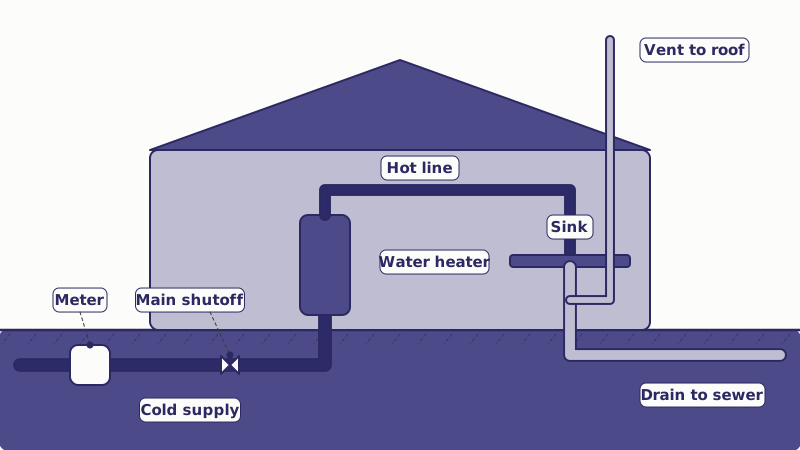
Plumbing in Los Angeles means old pipes, hillside pressure, hard water, gas appliances and a city permit system that treats a water heater swap as real work. City of Angels Plumbing is a mobile service for the City of Los Angeles. You describe the problem, a local plumber visits your home, and you are handed a written quote ahead of the job. This page explains what we arrange, what jobs cost, which rules apply and where the guides go deeper.
What does a plumber in Los Angeles actually deal with?
A plumber in Los Angeles deals mostly with leaks, clogs, water heaters, low pressure and pipe that has reached the end of its life. Many homes date from the 1940s to the 1960s, so supply lines and drains are old. Add hillside lots and hard water, and the same few faults come up again and again.
The most common calls, and the pages that answer them, look like this. A dripping or flooding pipe is covered in plumber for leaks. A blockage that will not clear is covered in plumber for a clogged toilet. A cold shower leads to water heater repair. Weak flow at every tap leads to plumber for low water pressure.
Many of these jobs are small, and the guides tell you which ones you can do yourself. Others, such as gas piping, a main line or a permitted water heater replacement, are work the law leaves to a plumber. The plumber service page describes what a visit involves.
How does a plumbing job run with City of Angels Plumbing?
You send a short form or ring us, we arrange a local plumber who works in your part of Los Angeles, that plumber contacts you to agree a visit, and then a written quote reaches you. Nothing begins until you agree. The work is then booked directly with the business that quoted it.
The visit is what makes the quote useful. A leak behind a wall, a corroded galvanized line or a slab problem cannot be priced from a phone description, and a figure given without seeing the job tends to change on the day. Seeing it lets the plumber price the parts, the permit and the repair of any wall that has to be opened.
The page on how a job runs sets out each step and who handles which part. The quote form is the place to begin. If you would rather talk, the contact page lists what to have ready, and you can read about the service on the about page.
What does a plumber cost in Los Angeles?
Printed cost guides place a Los Angeles plumber at roughly $100 to $200 hourly before parts and fees, with big jobs such as a repipe running into the thousands. The table below pulls the ranges from the cost pages on this site. They are guides drawn from published sources, and the real price is the written quote from the plumber who sees your job.
| Job | Guide range | Page |
|---|---|---|
| Plumber, hourly rate | $100 to $200 | How much a plumber costs |
| Emergency call | $200 to $400 | Plumber emergency |
| Plumber inspection | $75 to $500 | Inspection cost |
| Unclog a toilet | $110 to $275 | Toilet clog cost |
| Install a faucet | $120 to $480 | Faucet install cost |
| Replace a toilet | $350 to $800 | Toilet replacement cost |
| Replace a shut-off valve | $125 to $800 | Shut-off valve cost |
| Earthquake gas valve | $300 to $800 | Earthquake valve |
| Gas line, short run | $260 to $820 | Gas line cost |
| Leak detection and repair | $150 to $4,400 | Leak detection cost |
| Water heater, tank, installed | $881 to $1,826 | Water heater replacement cost |
| Water heater, tankless, installed | $1,400 to $3,900 | Tankless installation cost |
| Slab leak repair | $2,000 to $6,000 | Slab leak cost |
| Water softener, installed | $1,200 to $3,800 | Softener cost |
| Whole-house repipe, PEX | $4,000 to $10,000 | Repipe cost |
| Whole-house repipe, copper | $8,000 to $18,000 | PEX vs copper |
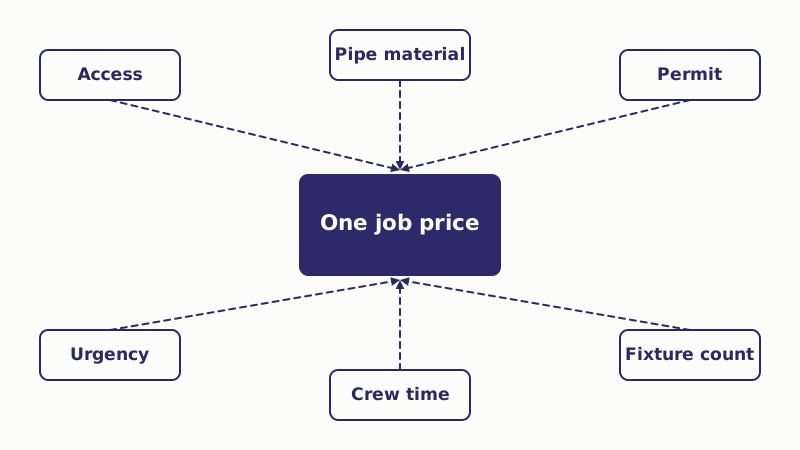
Two things move these numbers more than anything else. The first is access: pipe in an open crawl space is cheaper to reach than pipe behind tile. The second is the permit, where one is required. Ask every plumber whether the permit, the disposal of the old part and the wall repair are in the price. The service call cost page explains the visit fee separately.
Which plumbing problems should you act on first?
Act first on anything involving gas, flooding or sewage. If you smell gas, leave the building, once outdoors, phone SoCalGas on 1-800-427-2200, and dial 911 if there is danger. If water is spreading, shut off the main valve and read the burst pipe guide. Most other faults can wait for a daytime visit.
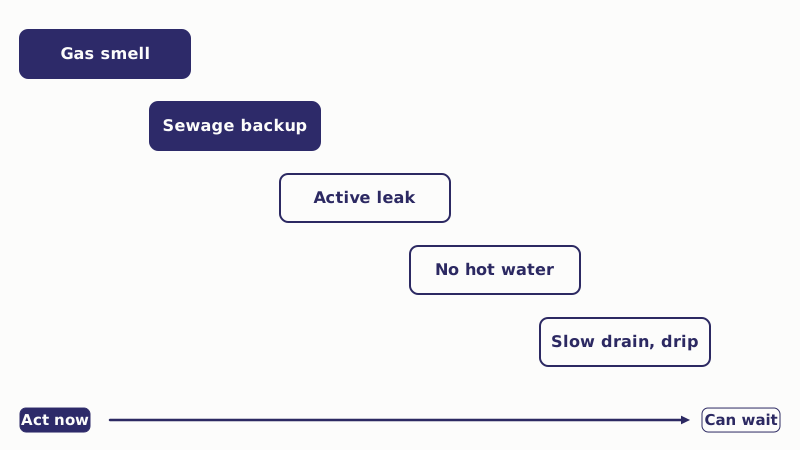
A burst or spreading leak is the most expensive failure to ignore, because water damage grows by the hour. The burst water pipe page walks through the first hour, and how to know if a pipe burst helps when the signs are hidden: a swollen wall, a stain, a bill that jumped. A high bill with no visible cause is covered in why is my water bill so high.
Sewage backing up is the third urgent case. Where several fixtures drain slowly or the lowest drain overflows, the blockage could sit in the main line. Within Los Angeles, the owner is on the hook for the private lateral running out to the street, while LA Sanitation looks after the public main.
Everything else, such as a running toilet, a slow sink or a dripping faucet, is worth fixing soon but not at midnight. Why your toilet keeps running is a good example: wasted water adds up, though nothing is in danger. Hours are weekdays, 9am until 5pm.
What should you know about water heaters in Los Angeles?
Know that replacing a water heater needs a permit, that tankless units cost more but take less room, and that California law requires heaters to be braced against earthquakes. Most heaters last roughly a decade or more, and a pooling base or rusty water is a failure warning worth acting on.
LADBS states that a permit is required to replace a gas water heater in a single-family dwelling. The only exception is a registered contractor swapping like for like, in the same gallon size, BTU rating and vent capacity. Moving from a tank to a tankless unit changes the rating and the vent, so it needs the permit. The water heater permit guide explains the process.
Choosing between types is the next decision. Tank vs tankless water heater compares them for Los Angeles homes, and tankless installation covers gas lines and venting. If a heater has failed outright, emergency water heater repair says what to shut off and when a repair is not worth it.
Small parts do much of the damage when they fail. The anode rod protects the tank from corrosion, the relief valve prevents over-pressure and the expansion tank absorbs pressure swings. Regular maintenance on these costs little next to a new heater, and the anode rod guide explains the simplest check.
Why do older Los Angeles homes have so many pipe problems?
Pipe materials have a lifespan, and many Los Angeles homes are past it. Galvanized steel rusts from the inside and loses flow, copper can develop pinholes, and cast iron drains can crack or scale. A home built around 1950 is now over seventy years old, and a repipe is often the sensible answer once leaks start repeating.
Census Reporter's ZIP profiles show how old the stock is. The typical home in Echo Park's ZIP, 90026, dates from 1945, and in West Adams, 90016, the median build year is 1949. In that era supply lines were commonly galvanized steel or copper. The galvanized pipe replacement page explains the signs, including brown water and falling pressure, and polybutylene replacement covers the gray plastic pipe used in some later homes.
When one failure follows another, repipe a house lays out the decision. Why repipe a house lists the signs, and the old house plumbing cost page sets out what drives the total. Slab leaks, where a pipe fails under the concrete floor, have their own guide in slab leak repair or repipe.
What causes low water pressure, high bills and hard water here?
Several things, and Los Angeles adds two of its own. Hillside homes lose pressure with height, about 1 psi for every 2.31 feet of rise above the main. Water hardness varies by area. A failing regulator, a hidden leak or old galvanized pipe can then make either problem worse.
Healthy home pressure is about 50 to 70 psi, which LADWP says is the band residential regulators are typically set in. A gauge on an outdoor hose bib tells you where you are, and the why is my water pressure low guide uses it as step one. How to fix low water pressure in a house lists fixes in order of cost, and the water pressure regulator page covers the valve itself. Readings above 80 psi are a problem too, and water hammer is one sign.
Hardness is a separate matter. Using 2022 data, LADWP's Water Quality FAQ lists average hardness by area: 8.6 grains per gallon in western Los Angeles and the San Fernando Valley, 9.8 in Downtown, Silver Lake and the south of the city, and 16.3 in the Harbor and the east side. LADWP says its water is safe. Scale on fixtures and in heaters is the practical effect, and removing hard water scale explains cleaning it, while water softener installation covers treating it.
Which rules apply to plumbing work in Los Angeles?
Three bodies set the rules. The state board known as the CSLB issues plumbing contractor licenses, LADBS issues city plumbing permits, and SoCalGas and LADWP control their own side of the meter. For gas, the law leaves the work to a plumber, and the guides stop where it does.
On licensing, a contractor license is required in California once the job passes $1,000 for labor and materials combined, or whenever a building permit is needed, and plumbing falls under the C-36 classification. Check the number at cslb.ca.gov before work starts. The CSLB also caps the down payment on home improvement work at 10 percent of the price or $1,000, whichever is smaller.
On gas, plumber gas line work explains what is regulated and gas plumber checks lists what to confirm before hiring. LADBS requires an approved seismic gas shut off valve whenever a building permit valued at $10,000 or more is issued for a building with fuel gas piping, which is why the valve matters in a remodel.
Remodels and new builds bring their own permit steps. Plumbing for a bathroom remodel and new construction plumbing cover what to plan before the walls close.
Do we help with businesses and apartment buildings?
Yes. We arrange commercial plumbers as well as home visits, for shops, restaurants, offices and apartment buildings. These jobs differ because one failure can close a business or leave a whole building without hot water, so the questions are about maintenance, response and records as much as price.
The commercial plumber service page explains what can be booked, and commercial maintenance plumber covers planned checks that prevent failures. For urgent failures, see emergency commercial plumber. Annual testing of protective devices is covered by backflow testing services.
Apartment tenants have their own page. Apartment building no hot water explains what happens when a shared heater fails and who to tell.
Which Los Angeles neighborhoods do we cover?
We cover the City of Los Angeles. Twelve neighborhoods have their own pages: Hollywood, Koreatown, Silver Lake, Echo Park, Highland Park, Eagle Rock, Boyle Heights, West Adams, Westchester, Miracle Mile, Los Feliz and Mar Vista. Each uses Census data and city rules to show what is different about the plumbing there.
The patterns are real. Hollywood and Koreatown are mostly renters in large buildings with shared stacks, while Eagle Rock has more owner-occupied houses. Mar Vista and Westchester sit on the Westside, where the two ZIP profiles show somewhat newer homes. The areas page lays out the comparison and links every neighborhood.
If your street is not named, you are probably still covered. Ask for a quote and give the address.
How do you choose a plumber and check what they say?
Request the contractor license number, verify it on the CSLB site, insist on a written quote and ask who pulls the permit. Be wary of a large deposit or a price that cannot be explained. A good plumber expects these questions and answers them without fuss.
The best rated plumber guide shows how to read reviews and spot warning signs, and plumber business near me covers the same ground for local firms. If you are curious about the spelling people search for, plummer or plumber settles it.
Every guide on this site lists its sources at the foot of the page. The full set is in the plumber guides, grouped by problem so you can find an answer without knowing the technical name.
Common questions
How much does a plumber cost in Los Angeles?
Typical published figures for a Los Angeles plumber run $100 to $200 per hour, with any call-out fee and parts extra. Small jobs such as unclogging a toilet run about $110 to $275, while a whole-house repipe can reach $4,000 to $18,000. What counts is the written quote the plumber gives after a visit.
Do I need a permit to replace a water heater in Los Angeles?
In most cases, yes. According to LADBS, replacing a gas water heater requires a permit in a single-family dwelling, with a narrow exception for registered contractors replacing a heater of the same size and rating. Ask the plumber who pulls the permit and whether the fee is in the quote.
What should I do if I smell gas?
Leave the building at once, take everyone with you and do not touch switches or devices inside. Once outside, ring SoCalGas on 1-800-427-2200, or 911 if there is danger. A contractor holding the right California license has to handle gas piping and appliance repairs, so do not try to fix the source yourself.
How can I check a plumber's contractor license?
Request the C-36 plumbing contractor license number, then search it on the state licensing board's site at cslb.ca.gov. Confirm it is active and that the name matches the business that quoted. In California, work of $1,000 or above for labor and materials needs a license.
Why is the water pressure low in my Los Angeles home?
Common causes are a partly closed valve, a failing regulator, a clogged fixture screen, old galvanized pipe or simply height: a hillside house loses about 1 psi for every 2.31 feet above the main. A gauge on an outdoor hose bib shows the reading, and 50 to 70 psi is typical.
Who actually does the work?
The job is quoted and done by a local plumbing business we work with. It answers for its own work, and it may pay us a fee for the introduction, which funds the service. Using the service costs you nothing extra, and the page on how a job runs has the detail.