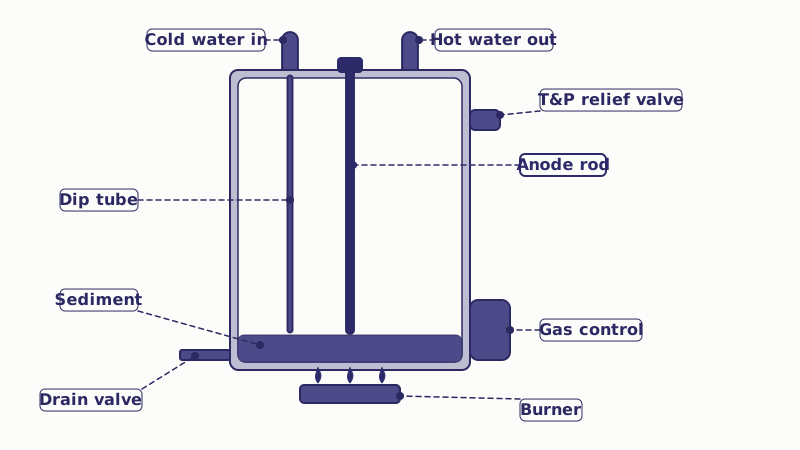
Replace your water heater's anode rod when more than half of its steel core shows, which in most homes means checking it about every three years and changing it every three to five. A new rod costs roughly $20 to $50, and a plumber's visit to fit one is typically around $200 to $300 according to published guides. A fresh rod can add years to a tank that would otherwise rust through. The rest of this page covers how to tell, which rod suits Los Angeles water, and what the job involves. If a bigger fault is behind your search, start from our water heater repair and replacement page.
What is a water heater anode rod?
An anode rod is a metal rod, usually magnesium or aluminum, that hangs inside the tank. Because it is a more reactive metal than the steel tank, the water attacks the rod first and the tank is spared. It is a sacrificial part, built to be used up and replaced.
The principle is the one behind sacrificial anodes on ships and pipelines, and it is called galvanic protection. The rod is threaded into the top of the tank, often under a hex head you can see on top of the heater. Once it dissolves down to the steel core, the water starts corroding the tank wall. That is why a heater with an old rod can fail early and one with a fresh rod can run well past the typical life of a tank.
How do you know the anode rod needs replacing?
Pull the rod and look. If it is eaten down to bare steel wire for more than about half its length, or it is coated in thick scale, replace it. Signs you can notice without pulling it include rotten-egg smells from the hot water, popping sounds, and a heater that is several years old and has never been checked.
Several guides say to check the rod about every two to three years, and Family Handyman suggests every three. A rod's life is shorter in soft or softened water, sometimes one to two years, so a home with a softener should check yearly. The rod is not visible from outside, so the only real test is taking it out. A plumber doing a service visit will often check it at the same time as flushing the tank.
Which anode rod is best for Los Angeles water?
Magnesium rods protect best and suit most homes. Aluminum or aluminum-zinc rods last longer in aggressive water and are the usual answer to a sulfur smell. A powered titanium rod does not dissolve and suits softened water, but costs more. Ask the plumber which fits your water and your heater.
The choice is based on what is in your water. LADWP classes water above 7 grains per gallon as hard. Its 2022 averages ran from 8.6 grains in the Valley and West Los Angeles, to 9.8 in Silver Lake, Downtown and South Los Angeles, to 16.3 in the east and the harbor area. Hard water forms scale on the rod and the tank, and heating it to high temperatures speeds that up, so scale-heavy parts of the city lean toward careful maintenance. Our page on removing hard water scale explains how scale builds, and a water softener installation changes the rod question, because soft water uses up a rod faster.
How do you replace a water heater anode rod?
Turn off the power or gas and the cold water supply, open a hot tap, and drain a few gallons to drop the level below the rod. Unscrew the old rod with a socket and breaker bar, usually a 1-1/16 inch socket, fit the new rod with thread tape or sealant as the maker advises, tighten, refill and check for leaks.
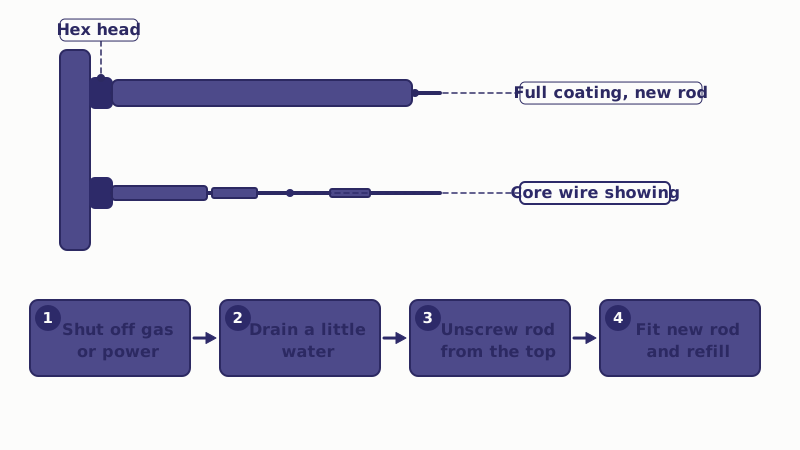
The rod is often stuck. A long breaker bar or an impact wrench helps, and so does holding the tank still so you do not twist the pipes. If there is no room above the heater to lift out a rigid rod, a segmented flexible rod bends in the middle and goes in through a short gap. Many homes in Los Angeles have water heaters in garages, closets and tight utility spaces, so check the ceiling clearance before you buy.
If the tank is already old, think twice. A rod that has not been touched in a decade may have fused into the fitting, and forcing it can damage the tank. In that case a replacement tank, or a quote from a plumber, is the sensible next step.
Do Rheem and other brands need a special rod?
Most tank heaters from the major makers, including Rheem, use a standard anode, but the length and fitting vary by model. Check the model number on the rating plate and the maker's parts list for the correct rod. Some makers' warranty terms refer to the anode, so read the manual before you change it.
A rod sold as universal may fit your tank but must be the right length and thread. Rheem and others publish anode part numbers for each tank, and some tanks have a combination hot outlet with the rod built in. If your model has one, the replacement is different. Do not guess, and match the part to the manual.
Can you replace the anode rod without a plumber?
Often yes, if you can shut off the power or gas and the water, drain the tank partly and work with a breaker bar. It is not gas piping work. Call a plumber if the rod is seized, the tank is old, there is no overhead room, or you would rather not risk a leak at the fitting.
On a gas heater, set the control to off first and relight the pilot only as the label directs. If you smell gas, leave the building and call SoCalGas on 1-800-427-2200 from outside. Our guide to anode rod replacement cost sets out what the visit price covers.
When is a new water heater the better choice than a new rod?
If the tank is leaking, rusted at the base, or well past its normal life, a new rod will not help. Steel that has already corroded cannot be protected. A heater with a rod in good condition and no leaks gains years from a rod change, while a heater with a leaking tank needs replacing.
In the City of Los Angeles, a replacement water heater needs a permit, and LADBS requires one for a gas heater in a single-family home with a narrow exception for like-for-like swaps by a registered contractor. Changing an anode rod is not a replacement, but if the inspection shows the tank has failed, read the plumber for water heater replacement page next. A tankless water heater has no tank and no anode rod, though it has its own scale maintenance.
We can arrange a local plumber to check the rod and the tank, and give you a written quote before any work starts. Tell us the heater's age and what you have noticed on the quote page. You can also see everything we arrange from the home page, where prices are shown as plain ranges.
Common questions
How often should I replace the anode rod?
Check it about every two to three years and replace it when more than half the steel core shows. Most rods last three to five years, and in softened water as little as one to two. Annual checks are sensible if your home has a water softener, or if the water heater is more than ten years old.
How much does anode rod replacement cost?
Published guides put the rod itself at about $20 to $50, and a plumber's visit to replace one at roughly $200 to $300. A powered titanium rod costs more, around $150 to $250. Prices vary, so ask for the part and labor on a written quote. The cost page linked above has more.
Does an anode rod affect water smell?
Yes, it can. In some tanks, a magnesium rod reacts with sulfur-reducing bacteria and produces a rotten-egg smell in the hot water. Swapping to an aluminum-zinc rod is a common fix, and flushing the tank also helps. A plumber can check whether the smell comes from the rod or the heater.
Will replacing the rod void my water heater warranty?
Not usually, but check the manual. Some makers require the rod to be checked or replaced as a condition of warranty, and a rod change by the homeowner is generally allowed when it is done properly. If the heater is still under warranty, ask the maker or the installer before you open it.
Can I remove the anode rod and leave it out?
You can, but it is a bad idea. With no rod the tank steel takes the corrosion directly, and the heater will fail sooner. Some people remove a rod to cure a smell, and then they need to watch the tank and plan for replacement. Replace it with a different type instead.