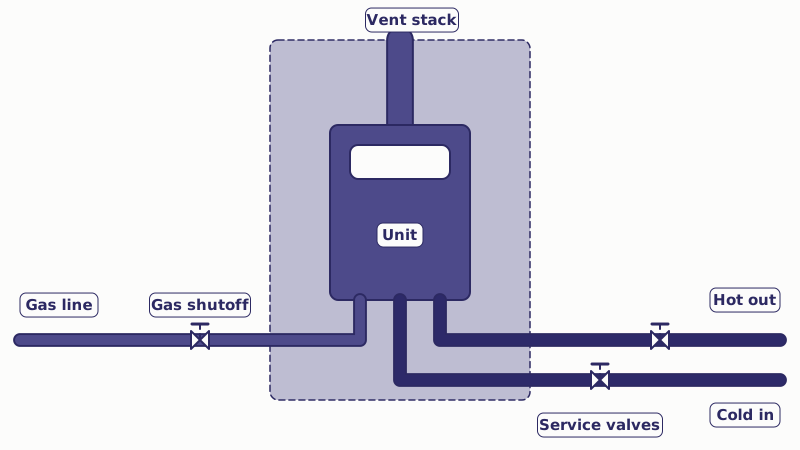
A tankless hot water heater installation has four parts: the plumbing connections, a gas supply or electrical circuit sized for the unit, a vent for gas models, and a permit with an inspection. In Los Angeles, the work is permit work and must be done by a plumber holding a California contractor license. Gas models usually need the largest changes, and an electric unit usually needs a heavy new circuit. Everything below covers what a good installation includes, so you can read a quote with confidence. Our water heater repair and replacement page shows the wider range of what we can arrange.
What does a professional tankless water heater installation involve?
A plumber removes the old tank or mounts the new unit on a wall, connects hot and cold water with isolation valves, connects gas or power, installs the vent for gas models, sets up condensate drainage if the unit condenses, tests for leaks, and commissions the unit. An inspection by the city closes the permit.
In more detail, expect these steps, usually in one visit for a like-for-like swap and one or two for a conversion:
- Shut off water, gas or power, and drain and remove the old heater.
- Mount the unit on a wall, often in the old tank's place or on an outside wall.
- Fit service valves on the hot and cold lines so the unit can be flushed later. This matters in hard water.
- Connect the gas line or run a dedicated circuit, and test the gas joints.
- Install the vent and any condensate line, and set the pressure relief valve discharge where the plans say.
- Fire up, check temperature and flow, and set the delivery temperature with you. Tankless units let you pick from a range of temperatures, so agree on the setting before the plumber leaves.
The valves in step three are the item people forget to ask about. Without them, a flush means cutting pipe.
Does gas or electric make a difference to the installation?
Yes. Gas units need a larger gas line than a tank, a vent to outside and usually an electric outlet for the fan and controls. Electric units need no vent or gas, but draw a lot of power and often need a new heavy-gauge circuit, and sometimes a panel upgrade.
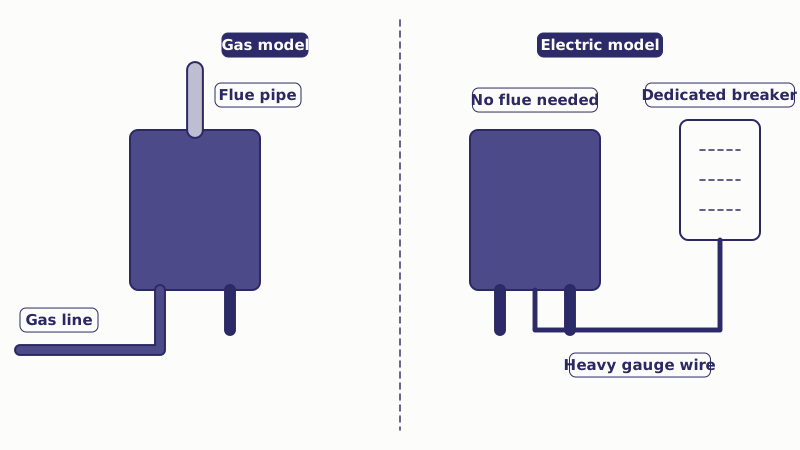
ENERGY STAR says tankless heaters need larger gas lines than tank heaters, and installation can cost more when the gas line or venting needs significant work. The Department of Energy adds that a gas unit typically needs an extra electric connection. For a natural gas installation, the gas piping and permit are the parts to confirm. Natural gas piping is regulated work, and the plumber must test every joint. If you smell gas at any point, leave the building, then call SoCalGas on 1-800-427-2200 from outside, and call 911 if there is immediate danger. See our page on a plumber for a gas line for how that work is handled.
Whether electric makes sense depends on your panel. A house with limited electrical capacity may find the circuit upgrade costs more than the heater saves.
What is a condensing tankless water heater, and does it change the installation?
A condensing tankless heater captures extra heat from exhaust and runs cooler vent gases, which lets it vent through plastic pipe in many cases and requires a condensate drain. Because the exhaust is acidic, the condensate may need a neutralizer. Your plumber follows the maker's instructions for the vent material and length.
The practical difference is the condensate line. It has to run to a drain with a continuous downward slope, and in a garage or a crawl space that can mean routing around obstacles. Non-condensing models vent hotter gases and typically need stainless steel vent pipe, which the Department of Energy notes can be expensive. Which type fits your home depends on where the heater goes and how far it sits from an outside wall.
What are the water heater installation code requirements in Los Angeles?
Installations must follow the California Plumbing Code and the Los Angeles plumbing code, which cover gas piping, venting, the relief valve and its discharge, clearances and testing. Beyond code, the maker's installation manual governs the unit and its warranty. A permit and inspection are required for water heater work in the city.
LADBS says a plumbing permit is required to replace a gas water heater in a single-family home, with a narrow exception for a like-for-like replacement by a contractor with a specific LADBS registration. A switch to tankless changes the vent and gas load, so we would expect to see a permit. In earthquake country there is also the question of gas shut-off. Our page on an earthquake gas shut-off valve explains it, and the inspection may check for one where applicable.
Another code point concerns the temperature and pressure relief valve. It must have a discharge pipe that runs to a safe visible point and is never capped. If you are curious how the permit paperwork works, see plumbing permit for a water heater.
Can a tankless heater be installed outdoors, and what about Rinnai, Navien, Rheem or Noritz?
Outdoor-rated tankless units exist, and a plumber may choose one when indoor space or venting is the problem. Los Angeles winters are mild, but cold nights still occur in some areas, so exposed pipes need protection. Brand matters less than the model, its input rating and the maker's installation manual.
Every major brand, including Rinnai, Navien, Rheem, Noritz and others, publishes its own installation manual and requirements for clearances, vent materials, gas pressure and water quality. The installer is bound by that manual. If a quote names a brand and model, ask for the manual number and make sure it matches the unit on the permit. Propane versions use a different orifice and gas supply, and a unit must be set up for the fuel it will burn. A recirculation pump is an optional addition that cuts the wait for hot water at distant taps, and some models have a built-in version.
Do Los Angeles air quality rules affect which gas unit can be installed?
They can. The South Coast Air Quality Management District adopted a rule in June 2024 to phase in zero-emission water heaters, with first compliance dates in 2026 and later dates for replacing units in existing homes. Reports on the exact timing for existing homes vary, so ask the installer which models can be permitted today.
A gas tankless unit sold in the district needs to meet the current low-NOx limit, and the longer-term direction is toward electric and heat pump models. This is a moving rule, and we are not going to guess at its dates. Check the AQMD site and your quote before you order a unit. If a gas tankless is not the right fit under the rules, a plumber can price an electric or heat pump alternative.
What if my water heater has no hot water, or I have hot water but no central heating?
If hot water has stopped, the cause is often a tripped breaker, a pilot that went out, a failed part or scale, and it should be diagnosed before you decide on a new unit. Hot water with no heating means the two systems are separate in most Los Angeles homes, because forced-air furnaces are common, and the furnace needs its own service.
Start with why you have no hot water, which sorts the causes by fuel type. A heater that is only a few years old with a simple fault is a repair, and an old tank leaking from the body calls for water heater replacement. For a tankless unit, error codes and scale in hard water are common, and LADWP rates water above 7 grains per gallon as hard, with 2022 averages from 8.6 to 16.3 grains depending on your part of the city.
How do you choose a plumber for a tankless installation?
Pick a plumber based on facts. Check the contractor license number on the California Contractors State License Board site, ask for a written quote that names the model and lists the permit, gas line, venting and haul-away, and ask who pulls the permit. Be cautious of a quote that has no permit line, or any request to skip inspection.
We can arrange a local plumber to come to your home, look at the existing heater, gas line and vent route, and give you a written quote before any work starts. Send the details on our quote page. You can also start from the home page to see the rest of what we arrange.
Common questions
How long does tankless hot water heater installation take?
A like-for-like swap often takes part of a day. A conversion from a tank, with a new vent, gas line or circuit, usually takes a full day or more, and the city inspection can fall on a different day. Your plumber should tell you the time and the water and gas outage window before starting.
What should I ask before I hire someone for the installation?
Ask for the license number and check it on the state site. Ask which model they will install and whether the quote includes the permit, gas line, vent, isolation valves and removal of the old heater. Ask what the manufacturer requires for the warranty, and what happens if the inspection finds an issue.
Does someone need to be at the property?
Someone should be there at the start to show access to the heater, the gas meter and the panel, and at the end to see the unit run and learn the controls. Water, gas or power will be off for part of the job, so plan around showers and cooking.
Can I install a tankless water heater myself in Los Angeles?
For gas piping and permit work, the law requires a contractor with the right license, and the city requires a permit. An unpermitted gas water heater job can create a safety risk and can cause trouble with insurance or a later sale. Leave this one to a plumber, and spend your effort comparing quotes.
Where can I find the installation manual for my model?
Every maker posts its installation manuals on its website, searchable by model number, which is printed on the unit's rating plate. Open the maker's site and download the one for the exact model on your quote, since vent lengths and clearances differ between models. Your plumber is bound by it, and it helps you check that the quote matches.