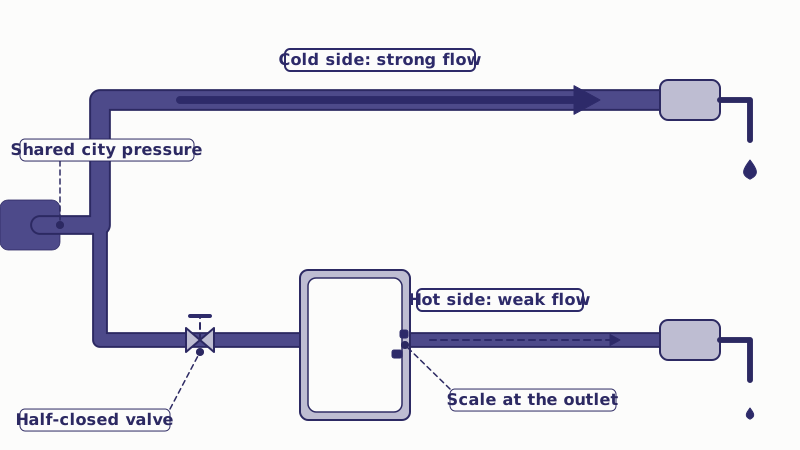
If the cold water runs strong and only the hot side is weak, the restriction sits somewhere between your water heater and the fixture. The usual suspects are mineral scale, a part inside the tank, or old galvanized pipe that has narrowed over decades. If both sides are weak, the cause is upstream and a different job. This page walks through how to tell which one you have, what you can check safely, and what a plumber does about it in a Los Angeles home.
Why is the hot water pressure low when the cold water is fine?
Because the two sides share the same city pressure until the water reaches the heater. Past that point the hot side has extra parts that can clog: the tank outlet, a heat trap or nipple, a mixing valve and a longer run of older pipe. A narrow spot in any of them cuts flow on the hot side alone.
Scale is the most common culprit in Los Angeles. LADWP reports average hardness of about 8.6 grains per gallon for the San Fernando Valley and western LA, about 9.8 for Silver Lake, Downtown and South LA, and about 16.3 for eastern LA and the Harbor. Heating hard water drops minerals out of it. They settle in the tank and flake off into the outlet, the aerators and the showerhead screens.
How do I tell whether the problem is the water heater or the whole house?
Run a quick comparison, which takes about ten minutes and no tools. Open the hot and cold tap at the same fixture and judge the flow. Then repeat at two other fixtures, ideally one close to the heater and one far away. The pattern tells you where to look.
| What you see | Likely location |
|---|---|
| Hot weak at every fixture, cold normal | Water heater, its outlet, or the main hot line |
| Hot weak at one fixture only | That fixture's aerator, cartridge or supply line |
| Hot and cold both weak, everywhere | Main shutoff, regulator or street supply |
| Hot weak in the shower only | Showerhead screen or a mixing cartridge |
| Hot starts strong, then fades | Sediment or a failing dip tube in the tank |
Unscrew the aerator on the weak tap and look for white or tan grit. If the grit is there, soak the aerator in vinegar and rinse it. Strong flow after that means you were chasing a fixture, not the heater. Our page on why water pressure drops in a house covers the cold-side and whole-house causes.
Can a water heater cause low hot water pressure?
Yes. Sediment, a broken dip tube and a partly closed valve can all throttle the hot side. A tank full of scale sheds chunks that lodge in the hot outlet, and the flow drops each time the water moves faster. A hot line with a half-closed shutoff valve does the same thing without any scale.
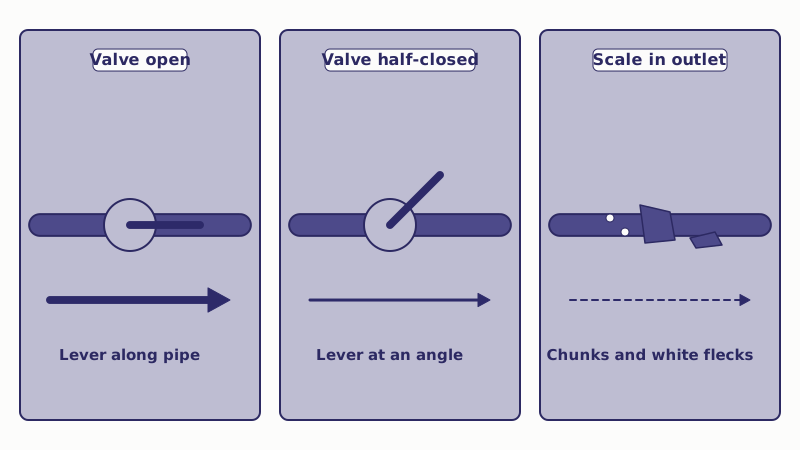
LADWP's own water heater advice mentions two of these. It recommends flushing the tank at least once a year, and it notes that some heaters have plastic dip tubes that turn brittle with age and break into small white pieces that turn up in hot water. White flecks in your aerators with no change in the cold side point at the tank.
Check these in order:
- Confirm the valve on the cold inlet above the heater is fully open. A quarter-turn ball valve should sit parallel to the pipe.
- Check any valve on the hot outlet, and any whole-house shutoff you recently touched.
- Look at the temperature setting. The Department of Energy points to about 120 degrees Fahrenheit for most homes. A very high setting hurries scale, and it is a scald risk.
- Flush the tank into a bucket or a hose run outside, with the power or gas control set to its off or pilot position first.
Stop if the drain valve will not close again, if water runs rusty and keeps running rusty, or if you cannot reach the valve safely. Those are plumber jobs, and a stuck drain valve is a leak waiting to happen. If the unit is old and the tank is heavy with scale, our guide to water heater replacement cost shows what the next step looks like.
What causes low hot water pressure in older Los Angeles homes?
Pipe is the usual cause in homes from the 1920s to the 1950s. Many were piped in galvanized steel, which rusts from the inside and builds up mineral crust. Over decades the opening shrinks, and hot water wears it faster than cold. The result is a hot line that delivers a trickle while the cold side, often replaced or less affected, runs full.
Hillside homes add another layer. LADWP says address pressure readings can be requested from its Water Distribution Services Section, and that older homes may lack a pressure regulator even where main pressure is high. Pressure at a hillside house depends on its height above the main, so two neighbors on one street can see different numbers.
Signs that point to old pipe rather than the heater:
- Pressure was always weak on the hot side and has slowly got worse.
- Water is brown or orange for a few seconds when first opened.
- Flow is poor at the far end of the house and fine near the heater.
- The pipe visible near the heater is gray, threaded steel, with rust at the fittings.
A plumber can confirm the material and measure static pressure with a gauge on a hose bib. If the pipe is the problem, the options are cleaning it, replacing the damaged runs, or repiping, and our page on galvanized pipe replacement explains how that works. A repipe is a larger project and one where a written quote with the scope spelled out matters.
When should I call a plumber for low hot water pressure?
Call when the quick checks do not restore the flow, or when you see a safety sign. A plumber can open the heater's connections, test pressure at several points, and tell scale from a failing part from a shrunken line. You get a written quote before any work starts.
Call sooner if you notice any of these:
- Rust-colored hot water that does not clear.
- A hot water pressure drop alongside a leak, a wet ceiling or a damp wall.
- Hot water that is also cooler than it used to be, which can mean sediment buildup or a failing element or burner.
- A relief valve that drips, which can point to an expansion problem rather than low pressure. See our page on water heater expansion tank replacement.
To book a visit, request a quote and mention the heater's age and which fixtures run weak, so the plumber arrives with the right gauge and parts. If the pressure problem turns out to be house-wide, our page on a plumber for low water pressure is the better starting point. Back on the home page you will find the rest of our plumbing services across Los Angeles.
Common questions
How long does fixing low hot water pressure take?
A clogged aerator or showerhead takes minutes. A tank flush or a dip tube swap usually takes an hour or two. A corroded galvanized line is a bigger job, from a half day for a short run to a few days for a whole-house repipe. A plumber should tell you which of these applies before starting, once they have tested pressure and looked at the pipe.
What should I ask before I hire someone to fix low hot water pressure?
Ask what they will test first, and whether they measure static pressure with a gauge. Ask if the quote covers finding the cause or only a guessed repair. Ask what the permit situation is if pipe or heater work is involved, and get the scope and price in writing. A plumber who offers to replace the water heater without testing the pressure first is guessing.
Does someone need to be at the property?
Usually yes, at least at the start and end of the visit. The plumber needs access to the water heater, the main shutoff and the fixtures you flagged, and you should see the pressure readings and the finished result. In an apartment, you may also need the landlord or building manager to approve entry to the water heater room or a shared mechanical area.