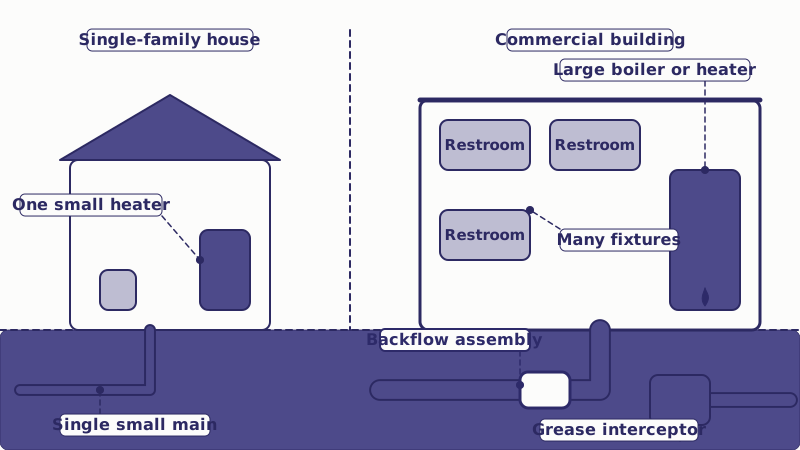
A residential plumber works on single-family houses, condos and small homes. A commercial plumber works on restaurants, offices, shops and larger buildings, where pipes are bigger, systems are shared and rules are stricter. In California both need a C-36 Plumbing Contractor license for larger jobs, so the real difference is experience and equipment. Our overview of commercial plumbing in Los Angeles covers the service in full.
What is the difference between a commercial plumber and a residential plumber?
The difference is the size and complexity of the system. A house has one water service, a few bathrooms and one kitchen. A commercial building may have dozens of fixtures, several risers, a grease interceptor, backflow assemblies and a large water heater or boiler, all in use at once by the public.
| Residential plumber | Commercial plumber | |
|---|---|---|
| Typical property | House, condo, small flat | Restaurant, office, shop, apartment building |
| Pipe size | Smaller supply lines and drains | Often larger supply lines and drains |
| Systems | Fixtures, water heater, gas appliances | Risers, pumps, grease control, backflow, large heaters |
| Schedule | Daytime, one household | Often around opening hours, nights, tenants |
| Paperwork | Permit for bigger jobs | Permits and plan check are more common |
| Typical rate | about $80 to $150 an hour | about $100 to $150 an hour |
These rate figures come from published guides and are not quotes. Our commercial plumber hourly cost page explains the numbers.
Do commercial plumbers and residential plumbers need different licenses?
Not in California. Both work under the same classification: the C-36 Plumbing Contractor license from the Contractors State License Board. The board says a license is required for plumbing jobs worth $over $1,000 once labor and materials are added, and for any job needing a building permit. The license does not split into residential and commercial.
That means the license alone will not tell you whether a plumber has handled a restaurant kitchen or a ten-story riser. Ask directly about similar jobs. Check the license number on cslb.ca.gov, then ask what kind of buildings the company usually works on.
When should I call a commercial plumber?
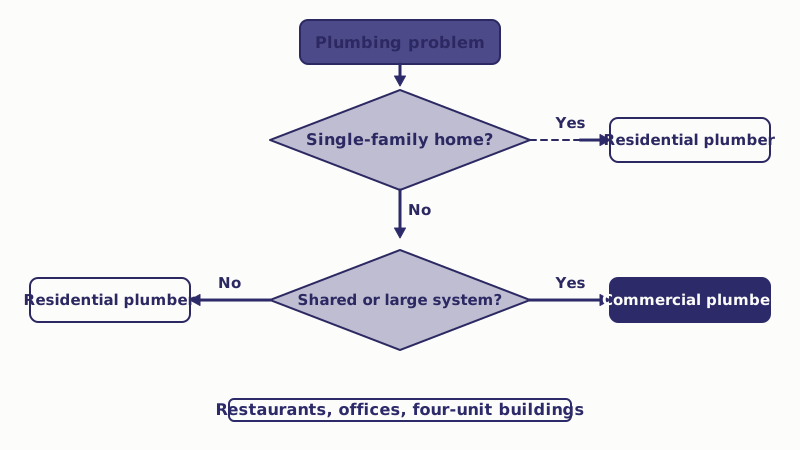
Call a commercial plumber when the building is not a single-family house, or when the system is large, shared or regulated. That includes restaurants, offices, medical suites, retail units, warehouses and apartment buildings. The same applies to any property where a failure affects tenants or the public, not just you.
Choose a commercial plumber for:
- A restaurant or café with a grease interceptor, floor drains and hand sinks.
- An apartment building where one blocked stack affects several units.
- Restroom additions or moves in a tenant improvement.
- Backflow testing and repair on a commercial water service.
- A large water heater or boiler.
- Maintenance contracts on a building you manage.
A mixed case is Commercial Residential property: a four-unit building, or flats above a shop. These usually suit a commercial plumber because the systems are shared and the owner has duties to tenants.
When is a residential plumber the better choice?
A residential plumber is the better choice for a single-family house or condo with a normal problem: a running toilet, a leaking faucet, a clogged shower drain, a failed water heater. They often work faster and cheaper on these jobs, with smaller vans and a flat-rate price list, and they are used to being in someone's home.
For house problems, see our guides on how to fix a leaky faucet and emergency plumber help for homes. If your problem is home-based but your building has a commercial kitchen or shared plumbing, use a commercial plumber.
Are the rules different for commercial plumbing in Los Angeles?
Yes, a commercial building usually carries more rules. LA Sanitation's Fats, Oils and Grease program covers food service establishments, with an Industrial Wastewater Permit, grease removal devices and, for new construction or a remodel valued at $100,000 or more, a grease interceptor. LADWP Rule 16-D sets backflow prevention requirements, including annual testing.
LADBS permits apply to most plumbing work in the City, and larger commercial jobs normally go through plan check with drawings. A house repair often has a lighter process. A commercial plumber who knows these rules saves time with inspections and avoids rework. Check each requirement with the agency for your property.
Can one plumber do both kinds of work?
Yes. Many plumbing businesses work on houses and commercial buildings, and the trade skills are the same, so you do not always need two companies. What differs is the experience with large systems, the equipment (jetting machines, cameras, lifts) and the way the work is scheduled.
When you send us a request, tell us the building type and the problem. We'll arrange a local plumber whose usual work matches it, and you get a written quote before any work starts. The home page explains the steps.
Common questions
Is a commercial plumber more expensive than a residential plumber?
Usually a little, per hour. Published guides put commercial work near $100 to $150 an hour and residential near $80 to $150, with emergency work higher for both. The total job often costs more because commercial systems are larger and permits and access take longer. The plumber quotes the real price after seeing the job.
Can a residential plumber work on a commercial building?
Legally, a plumber with a C-36 license can, since the license is not split by building type. In practice, ask whether they have done similar work. A business with a grease interceptor, backflow assembly or multi-story risers needs someone who knows them. Ask for examples of comparable jobs and the license number.
Do apartment buildings need a commercial plumber?
Often, yes. Apartment buildings have shared stacks, large water heaters and several tenants affected by any shutoff, which suits a commercial plumber. For a single apartment or condo unit with a fixture problem, a residential plumber is usually enough. Ask the building manager who controls the shared pipes before you call anyone.
Which one should I call for a home-based business?
It depends on the plumbing, not the business. If you work from a normal house with a normal system, a residential plumber is fine. If you have added a commercial kitchen, extra restrooms or a separate unit that is zoned commercial, call a commercial plumber. When unsure, describe the setup and we'll arrange the right match.
How do I check that a plumber holds the right license?
Look the license number up on the Contractors State License Board site at cslb.ca.gov. It shows whether the license is active and its classification, and you should see C-36 for plumbing. Never rely on a business card or a truck. If the plumber cannot give a number, do not proceed on a job over $1,000.