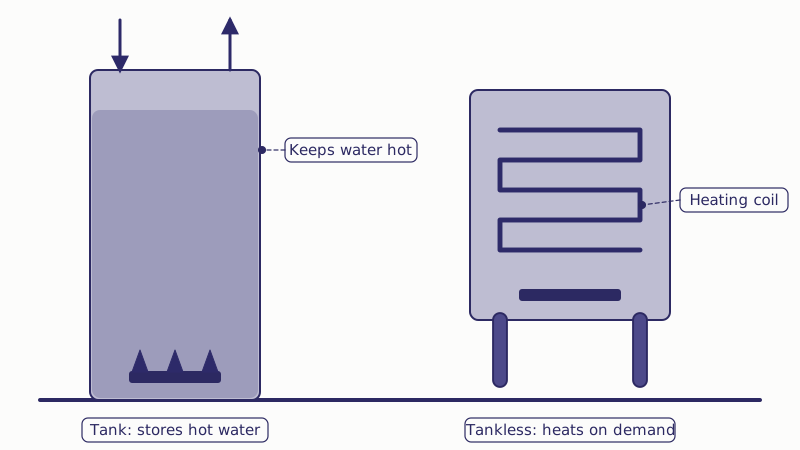
Choose a tankless water heater if you want lower running costs, a smaller unit on the wall and hot water that does not run out, and you can afford the higher price and the gas, vent or electrical work it needs. Choose a tank if you want the lowest upfront price and a straight swap of what you have. For most Los Angeles homes with a tank that is failing, the deciding factor is the work around the heater, not the heater itself.
This page compares the two on cost, savings, lifespan and local rules. It is part of our water heater repair guide, and it will help if you are deciding between a repair and a new unit.
Is it cheaper to repair a water heater or replace it?
Repair is cheaper if the tank is sound and the heater is under about ten years old. Replace when the repair costs more than half of a new unit, when the tank itself leaks, or when a storage heater is in the 10 to 15 year range the U.S. Department of Energy gives as its usual life. A replacement is also the moment to choose between tank and tankless.
If you are not sure, ask a plumber to quote both on one sheet: the repair, and a replacement of the same size. The repair side of that comparison is priced in the main guide above, and the page on water heater replacement cost lists the other side of the comparison.
What is the difference between a tank and a tankless water heater?
A tank heater stores 30 to 80 gallons of hot water and keeps it hot all day. A tankless, or on-demand, heater has no storage: a gas burner or electric element heats water as it flows through. A tank runs out when you use the stored water. A tankless unit keeps going, but only up to its flow limit.
That flow limit is the part people miss. A tankless heater is rated in gallons per minute at a certain temperature rise. If a shower, a dishwasher and a washing machine run together, a small unit can fall short and the water cools. A plumber sizes it from how many fixtures run at once, not from the number of people in the house.
A mini-tank is a third option: a small tank of a few gallons placed under one sink for a quick supply of hot water. It is not a whole-house heater and is only worth considering for a distant sink.
How much do tank and tankless water heaters cost in Los Angeles?
Angi puts the Los Angeles average for a water heater replacement at about $1,740, with most homes paying $1,140 to $2,410. A tank unit ranges from about $775 to $3,275, and a tankless unit from $1,850 to $5,100. Tankless usually costs about twice as much to install as a tank.
| Type | Guide range installed |
|---|---|
| Tank, gas or electric | $775 to $3,275 |
| Tankless, gas or electric | $1,850 to $5,100 |
| Typical local plumber quote, tank | $1,200 to $2,500 |
| Typical local plumber quote, tankless | $2,500 to $5,000 |
These are guide figures from the Angi cost guide for Los Angeles and from published prices of Southern California plumbing businesses, checked in November 2026. Your written quote is the real price. A comparison article from 2016 will show prices that are out of date.
Why tankless costs more: the unit itself, a bigger gas line, new venting through the wall or roof, a condensate drain on high-efficiency models, and sometimes a new circuit if the unit is electric. See installation of a tankless water heater and the page on tankless installation cost for the details.
How much does a tankless water heater save?
The U.S. Department of Energy says a tankless heater can be 24 to 34 percent more energy efficient than a storage tank in a home that uses 41 gallons or less of hot water a day. In a home that uses a lot of hot water, around 86 gallons a day, the gain shrinks to 8 to 14 percent.
So the savings depend on how you live. A couple in a Koreatown apartment who use 30 gallons a day will see the biggest gain. A household of six with long showers and daily laundry will see much less. A calculator on a website cannot know your usage. A simple test: if the upfront difference is $2,000 and you would save $100 a year, it takes 20 years to break even, which is the whole life of the unit.
Efficiency is not the only gain. A tankless unit takes up less floor space and avoids the standby loss of keeping a tank hot all day. A tank is a heavy item in an earthquake region, and strapping it is a requirement.
Which lasts longer, a tank or a tankless heater?
Tankless units last longer. The U.S. Department of Energy says most storage heaters last 10 to 15 years, while tankless units can last more than 20 years. Tankless units avoid the tank corrosion that ends most storage heaters, but they need regular descaling in hard water, and that matters in much of Los Angeles.
LADWP reports average hardness of 147 mg/L in the San Fernando Valley and western Los Angeles, 168 mg/L around Silver Lake, downtown and South Los Angeles, and 279 mg/L in eastern Los Angeles and the Harbor area. LADWP says even its hardest water does not need softening to be safe, but scale can build up inside a heat exchanger. Ask a plumber about a descaling visit once a year and whether a water softener makes sense for you.
Repair costs are different too. A tankless unit has more electronics and a heat exchanger that is costly to replace. Published prices for tankless repairs run roughly $200 to $1,100, and a heat exchanger or control board sits at the top of that range.
What work does a switch to tankless involve in Los Angeles?
A switch from a tank to a gas tankless unit usually means a larger gas line, new venting, a condensate drain and a permit. An electric tankless unit draws a heavy electrical load, so the panel and wiring may need an upgrade. A tank-for-tank swap avoids most of this, which is why it costs less.
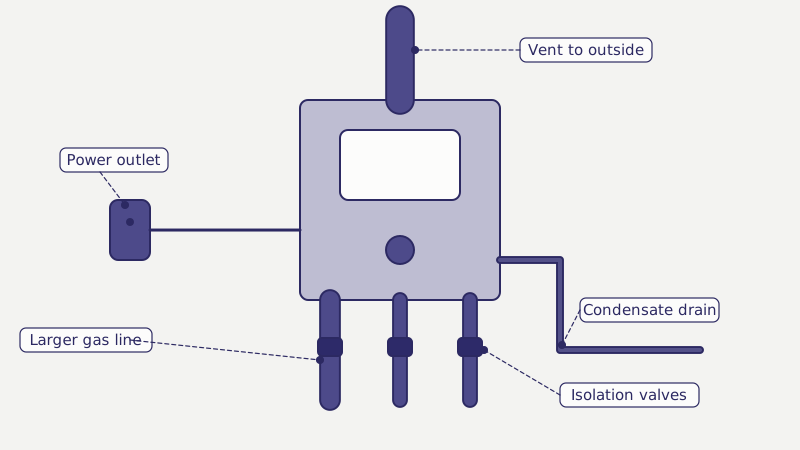
Los Angeles has specific rules to consider:
- Permit: LADBS says a plumbing permit is generally required to replace a gas water heater in a single-family home. The exception is a same-size swap by a contractor in the LADBS contractor registration program. A move to tankless is not a same-size swap, so expect a permit.
- Gas piping: Gas work must be done by a plumber with a California contractor license. If you ever smell gas, leave the building and call SoCalGas on 1-800-427-2200 from outside.
- Emissions rules: South Coast Air Quality Management District adopted Rule 1146.2 in June 2024, with zero-emission dates that begin in 2026 for some new-building units and later for existing buildings. It applies to larger gas units, including tankless models. Ask which rule applies before you choose a unit.
- Location: A tankless unit can go outside on a wall in many homes, which frees a closet or garage corner. Outdoor units need to suit the climate and clearances. A plumber checks this on the visit.
Older Los Angeles homes add a wrinkle. A house from the 1920s to 1950s may have a gas line sized for a tank, and a vent that was run through the roof. Ask the plumber to look at both before they quote a tankless unit.
Should I choose gas, electric or propane?
In most Los Angeles homes the choice follows the fuel you already have. Gas units cost less to run in most cases, but need venting. Electric tank units are simple and cheap to install, while electric tankless units need a big electrical supply. Propane is uncommon in the city and mainly appears in homes without a gas line.
Gas and electric heaters have different efficiency profiles, and electric units cost more per unit of heat in many areas. Heat pump water heaters are a fourth option that uses much less electricity than a standard electric tank. They need space and air around them. Ask the plumber for a price on a heat pump unit as well as a tank and tankless.
For faults on a gas tank, see gas water heater repair, and for an electric one, our Rheem electric water heater repair page covers the common faults.
Which should you pick?
Pick a tank if the budget is tight, the existing gas line and vent suit it, or the household uses a lot of hot water at once. Pick tankless if you plan to stay for 10 years or more, want to free floor space, or your hot water use is modest. Pick based on the whole job price, not the unit price.
A quick way to decide:
- Get a written quote for a tank swap and a tankless install from the same plumber.
- Divide the price difference by the yearly saving you expect. If the answer is past 10 years, the tank wins.
- Ask what extra work each quote includes: gas line, venting, permit, haul-away of the old unit.
- Check what the maker's warranty covers and who handles claims.
If you want to talk to a plumber, use the quote page and say which options you are comparing.
Common questions
Is a tankless water heater worth it?
It can be, if you use modest amounts of hot water, plan to stay for years and your home suits the gas, vent or electrical work. The U.S. Department of Energy says tankless units can be 24 to 34 percent more efficient in homes using 41 gallons a day or less. In a high-use home the gain is much smaller.
Does a tankless water heater give unlimited hot water?
Not quite. It heats water as it flows, so it never runs out, but it can only heat so many gallons per minute. If too many fixtures run at once, the water turns lukewarm. A plumber sizes the unit by the fixtures you use together, so tell them about big tubs and double showers.
Can I replace my tank with a tankless water heater myself?
No. Gas piping, venting and the permit are regulated work, and in California gas work is done by a plumber with a California contractor license. A wrong vent or gas line can cause carbon monoxide or a gas leak. Do not attempt it yourself. Ask a plumber for a quote that includes the permit.
Does tankless work in a hard water area?
Yes, but it needs descaling. Minerals build up inside the heat exchanger and cut flow and efficiency. LADWP's hardness ranges from about 93 to 291 mg/L across its zones. Plan on an annual descale, and ask whether a softener or scale filter is sensible for your address.
Is propane better than natural gas for a tankless heater?
Natural gas is more common and cheaper in the city, so propane only matters where there is no gas line. A propane unit needs a different gas valve setting and a storage tank. Ask the plumber for the conversion or the right model, and do not convert a unit yourself.