Plan on $1,200 to $3,800 for a water softener installed in a home, unit included. Labor alone usually runs $300 to $800, with a published range of $150 to $1,000. These are national guides, so treat them as a starting point: Los Angeles labor rates are often higher than the national average, and your quote may sit toward the upper end. The water softener installation plumber page explains the job itself.
What is the average water softener installation cost?
Published guides put the all-in price, equipment plus installation, between about $1,200 and $3,800. HomeGuide's national average is around $2,500, and Angi reports a lower average near $1,500 because its range includes basic single-tank units. Professional labor alone commonly lands between $300 and $800, and a published range runs $150 to $1,000.
Treat the lowest numbers with caution. A price that leaves out the drain work, the permit or the first load of salt can look cheap on paper and grow on the day. Many of these guides come from businesses that sell water treatment, so they are estimates, not a price list. Your local quote is the real figure.
| What you are paying for | Typical range (guide) |
|---|---|
| Plumber labor, straightforward install | $300 to $800 |
| Labor, direct swap on an existing loop (1 to 2 hours) | $150 to $350 |
| Labor, full-day job with no loop, drain or outlet | toward $1,000 or more |
| Plumbing changes to make the install possible | adds $500 to $2,000 |
| Permit, where one is required | $50 to $150 |
| Complete installed price, unit and labor | $1,200 to $3,800 |
What does a water softener system installation cost with a loop?
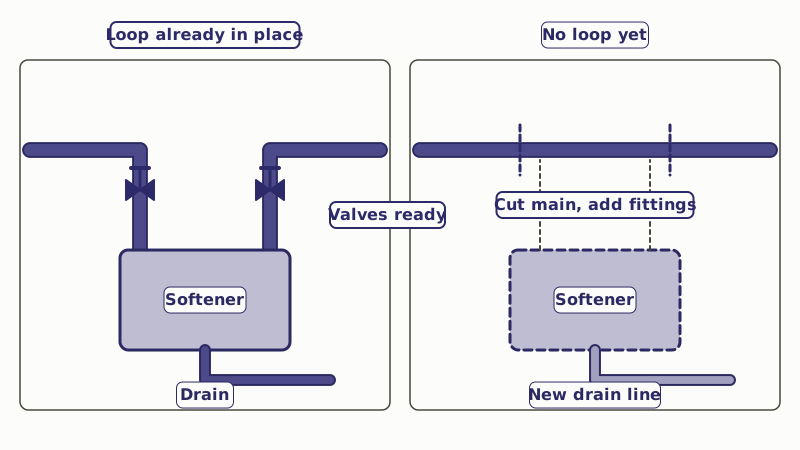
A softener loop is plumbing already built in or beside your main line with a bypass, ready to accept a unit. If your house has one, installation is a short swap, often $150 to $350 in labor. If it does not, the plumber builds it, and published guides say plumbing modifications can add $500 to $2,000. Ask whether your house has a loop before you shop.
In Los Angeles, loops are not universal. Many older homes have none, and the main may be in a spot that needs new pipe to reach a good location. Ask a plumber to look at where the main enters and where a drain and outlet are. That tells you in a few minutes which price bracket you are in.
The loop also decides what you can do yourself. Where a ready loop exists, the swap is simple. Where it does not, you are cutting into the main, which is why the how-to guide for water softener installation separates the two cases.
What pushes the price up or down?
Four things move the number most: the type and size of the softener, whether the house is already plumbed for one, how far the unit sits from a drain and a power outlet, and whether a permit is needed. Pipe condition and emergency timing matter too. Emergency installs cost 50 to 100 percent more in the guides.
Unit choice swings the total. A single-tank salt-based softener costs less than a dual-tank unit, and a salt-free conditioner has a different price and works differently. Wikipedia's water softening article explains that salt-free systems condition hard water rather than remove the minerals.
Plumbing condition matters in older Los Angeles houses. Galvanized pipe or corroded fittings near the main can mean replacing a few feet before a softener can go in. LADWP also notes that softened water is more corrosive to plumbing, so a plumber may suggest checking the pipes first. If pressure is already poor, see why water pressure runs low.
Licensing can raise cost without announcing itself. California requires a CSLB contractor license for work worth $1,000 or more, and for any work that requires a building permit. A softener install with equipment commonly crosses $1,000, so a handyman quote that skips the license is a risk, not a saving.
How much do Kinetico, Culligan, Rheem and Costco installations cost?
Brand sets the price of the unit, not the plumber's labor. We have no sourced, current dealer prices for Kinetico, Culligan, Rheem, AquaSure or Costco units, so we will not quote one. Brand-run installations are often bundled into a package price, and a Costco, retailer or dealer purchase may include installation at their rate. Compare the bundle with a plumber's separate quote.
Here is how to compare fairly. Ask each dealer for the unit price, the installation labor, drain and loop work, permit fees, delivery, salt and any service plan, each as a separate line. A bundle that looks cheap can bury a pricey service contract. A plumber's quote for installing a unit you bought yourself covers labor and parts only.
Some brands use dealer-only models or proprietary parts, which can limit who can service them later. Ask who services the unit and whether a local plumber can work on it. That question alone changes the real cost over ten years.
Is there a water softener installation cost calculator?
Online calculators can give a ballpark, but they cannot see your house. A decent estimate is simple to build yourself: unit price, plus labor of $300 to $800, plus $500 to $2,000 if you need plumbing changes, plus a permit of $50 to $150. Add a margin for Los Angeles labor rates. Then ask a plumber to replace the guesses with a written quote.
Run it twice, once for a house with a loop and once without, and you will see how much of the price is the unit and how much is the plumbing. For most homes the unit is the bigger share, so a cheaper plumber saves less than a careful choice of unit.
Plumbers in general charge by the job or by the hour for this work. For hourly rates across plumbing work in Los Angeles, see plumber cost.
How do you compare water softener quotes?
Get at least two written quotes that list the same things: the unit model and capacity, labor, drain and loop work, permit and inspection, the first fill of salt and what happens if the plumber finds a problem mid-job. Then compare line by line, not total to total. Ask who pulls the permit and who checks the license.
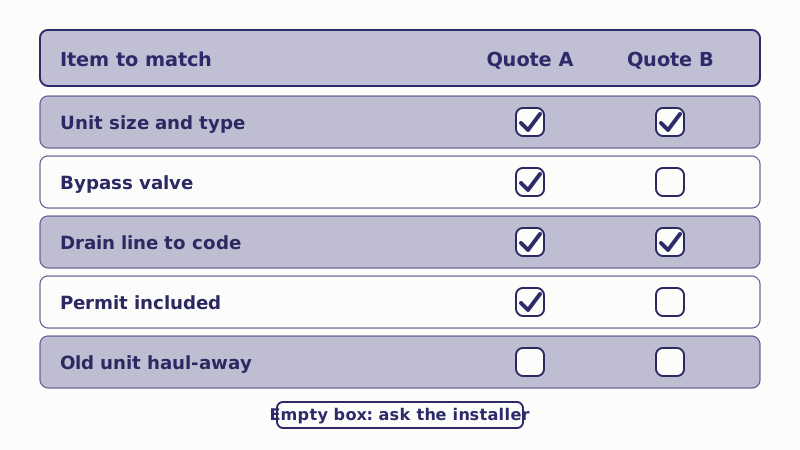
Check the license number at the CSLB site before you sign. Ask whether the price changes if the pipe behind the wall turns out to be worse than it looks, and how that change would be agreed in writing. Be wary of a large deposit on a job this size.
Ask what the softener does for the hard water you actually have. LADWP's 2022 averages are 8.6 grains per gallon in the Valley and western Los Angeles, 9.8 in Silver Lake, Downtown and South Los Angeles, and 16.3 in eastern Los Angeles and the Harbor. LADWP also says even its hardest water is safe and usable without softening. Whether a softener pays for itself in appliance life, detergent and cleaning time is your call. You can request a quote and a local plumber comes to your home to see the setup before pricing.
Common questions
Does a softener raise my water bill?
A softener uses extra water to regenerate, usually a modest amount per cycle. The size depends on the unit and how hard your water is. If your bill jumps after installation, the cause is often a stuck valve or a leak, so see why your water bill is so high for how to check.
Does installation cost more if I buy the unit myself?
Not necessarily. A plumber may charge labor only, and some prefer to supply the unit. Ask in advance, because a plumber who installs equipment you bought elsewhere may not stand behind the unit itself. The difference is in warranty handling, not in how the plumbing is done.
Does a plumber need a permit to install a softener?
Contractor sources in Los Angeles say a permit is needed when the softener ties into the main water line, and published guides give a permit fee of $50 to $150. We could not confirm that on an official page, so ask LADBS or have the plumber confirm before the work starts.
How long does a typical installation take?
A swap on an existing loop takes one to two hours. A first-time installation with a new drain, outlet and loop can take most of a day. Add time if the plumber needs to replace corroded pipe near the main. Ask for the expected duration in the quote.
Is a softener worth the money in Los Angeles?
LADWP says its water is safe without softening, so this is about scale and comfort. Most Los Angeles water is classed hard, over 7 grains per gallon, and parts of eastern Los Angeles and the Harbor run higher. If you see scale on fixtures and in your water heater, a softener can reduce it. Weigh that against sodium and corrosion concerns.