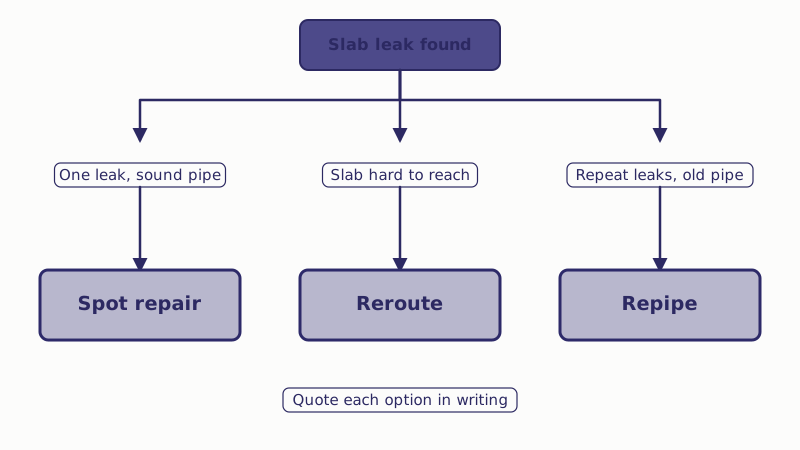
If you have one leak in otherwise sound pipe, a spot repair through the slab is often enough. If the leak is repeated, or the pipe is old, a reroute or repipe usually costs more now and less over time. Epoxy lining sits in the middle and suits pipe that is still structurally sound. We arrange a local plumber who comes to you, confirms the leak and quotes in writing. The wider overview sits on our page for a plumber for leaks.
What does slab leak repair or repipe involve?
A plumber first locates the leak, then chooses between four paths: cut the slab and replace the damaged section, abandon the buried line and run new pipe through the walls or attic, coat the inside of the old pipe with epoxy, or replace the home's supply piping entirely. Each path trades cost, mess and longevity differently.
Spot repair. The plumber pinpoints the leak, breaks out a section of concrete, cuts out the failed pipe and fits a new section. It is the least costly path when there is one clear failure. Floor finishes over the slab must be removed and replaced.
Reroute. The leaking line is capped at both ends and new pipe, commonly PEX, runs overhead through the attic or inside walls. The slab stays intact, but walls and ceilings are opened and patched.
Epoxy lining. Pipe is cleaned and coated from the inside. It avoids cutting concrete and walls. Contractors disagree on how well it lasts, and it does not suit badly corroded or collapsed pipe.
Full repipe. All supply lines are replaced, usually with PEX or copper. It costs the most and ends the guesswork, and it is the usual answer when leaks keep coming back.
A job that changes or adds water piping generally needs a plumbing permit. The Los Angeles Department of Building and Safety requires one for installation or modification of potable water piping, so ask whether your quote covers it.
How much do these options cost in Los Angeles?
Published Los Angeles prices, from plumbing businesses, run roughly $2,000 to $4,500 for a spot repair, $1,500 to $6,000 for a reroute, $1,500 to $8,000 for epoxy lining, and $4,500 to $15,000 or more for a full repipe. Leak detection is usually $150 to $400 extra. These are guides, and sources disagree.
Prices climb with finish materials, the number of leaks, the size of the house and access. A slab under a tiled kitchen costs more to open than a garage floor. Two bathrooms and a long run to the water heater cost more to reroute than one short line.
Full cost detail, with a table of ranges and what the quote should list, is in our slab leak repair cost guide. A repipe done for its own sake is covered under repiping a house.
Should I repair, reroute or repipe?
Choose a spot repair for a single leak in pipe that is otherwise in good shape, a reroute for repeat leaks on one line or pipe you cannot reach cheaply, and a repipe when several lines are failing or the pipe is old. Published guidance suggests two or more leaks, or pipe past about 30 years, points to repiping.
Ask the plumber these questions to test any recommendation:
- How many leaks have you found, and how did you confirm each one?
- What is the pipe made of, and what shape is the rest of it in?
- What happens to the old pipe under the slab?
- What does the price include for flooring, drywall and permit?
If you have had a leak on the same line before, a spot repair is the weaker bet. Another failure in the same pipe is likely, and reopening the slab twice costs more than one larger job. If the pipe is copper with pinholes in several places, many plumbers lean toward replacement. Others will line it. A good plumber explains why and shows you the pipe.
For a home built on a slab, the best way to repipe is usually overhead through the attic and walls, with PEX or copper, so the slab is not touched. That is not always possible, which is another reason to get a written scope before you agree.
What signs point to a slab leak?
A warm spot on the floor, the sound of running water when everything is off, a water heater that never stops cycling, a meter that moves with all fixtures off, a sudden rise in your bill, or damp carpet and flooring. Together, a warm patch and a constantly running heater strongly suggest a hot-water leak under the slab.
You can run the meter test yourself. Turn off every fixture and appliance, then watch the small leak dial on the meter. Closing the cold-water valve at the water heater and watching again helps show whether the leak is on the hot side. The US EPA suggests a similar meter check over two hours.
A warm floor can also come from heating ducts, a nearby water heater or radiant heat, so a plumber confirms with listening equipment and thermal imaging before opening concrete. Our main leaks page covers the detection steps, and the cost of leak detection is on its own page.
Does insurance cover a slab leak?
It depends on the policy and the cause. Many policies cover the resulting water damage when a leak is sudden and accidental, and some pay to reach the pipe through the slab. Slow leaks from corrosion or wear are often excluded, and the pipe repair itself may not be covered. Report it early and read the wording.
A plumber's written report, with the leak location, photographs and pipe condition, helps a claim. Our page on slab leak coverage and burst pipes explains the usual pattern. If a claim is denied, you can ask the insurer for the reason in writing and contact the California Department of Insurance.
What should the written quote say?
It should name the method, the leak location, the pipe material, the permit, what the price includes for flooring, drywall and paint, how long the water will be off and when payment is due. California limits a down payment on a home improvement contract to the lesser of $1,000 or 10 percent, with a few exceptions.
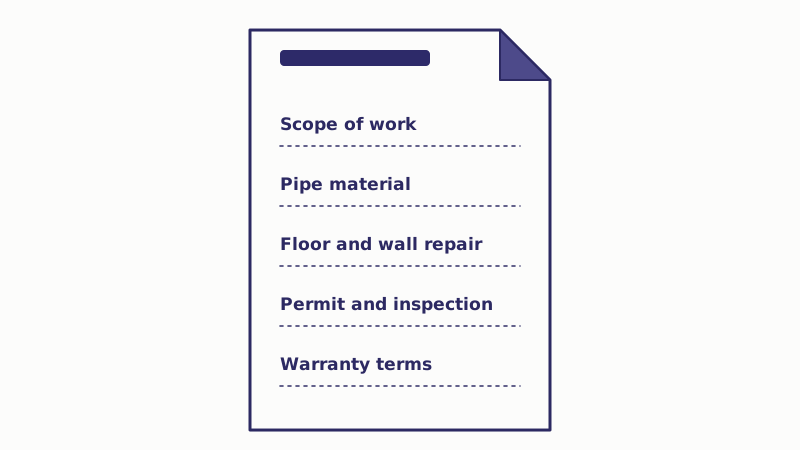
For work worth $1,000 or more, California requires a state contractor license, and you can check the number on the CSLB website. The CSLB also publishes a guide to what a home improvement contract must contain. Compare two or three quotes on the same scope, not on price alone.
Common questions
How long does slab leak repair or repipe take?
A spot repair or reroute is often one to two days, plus time for flooring or drywall. A full repipe can take several days, depending on the size of the house and the access. Ask for the schedule in the written quote, including how long the water will be off each day, since that affects how you plan.
What should I ask before I hire someone for slab leak repair or repipe?
Ask how they found the leak, which method they recommend and why, whether the price covers the permit, flooring and drywall, and what happens if a second leak shows up. Ask for a written quote. For jobs of $1,000 or more, check the contractor's state license on the CSLB website.
Does someone need to be at the property?
Be there at the start to show where you noticed the problem and at the end for a walk-through. During a repipe, someone responsible should be present most days, because the plumber needs access to rooms, the meter and the main valve. Plan for the water to be off for part of each day.
Is epoxy lining a good option for a slab leak?
It can be, on pipe that is still sound, because it avoids cutting concrete and walls. Contractors disagree about how long it lasts, and it does not suit pipe that is badly corroded or has an active large leak. Ask the plumber how they will test the pipe, what the lining is rated for and what the warranty covers.
Can I fix a slab leak myself?
Not realistically. Finding the leak needs equipment, cutting a slab needs the right tools and care around other lines, and the repair may need a permit. A temporary measure is to shut off the water to the affected line and call a plumber. Never cut into a slab near gas or electrical lines.