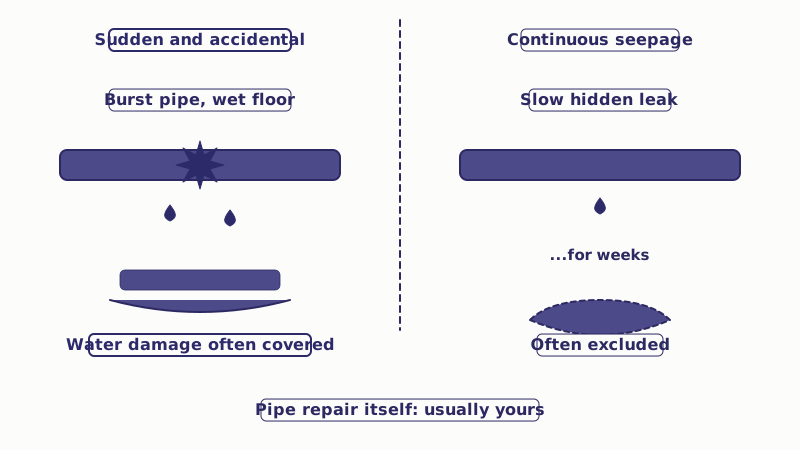
A standard homeowners policy in California usually pays for the damage a sudden, accidental burst does to your home, such as wet drywall, floors and belongings. It usually does not pay to fix the broken pipe itself, and it usually excludes damage that built up slowly over time. Your policy wording has the final say. We can't read it for you, but we can explain what to look for. The leaks and burst pipes hub covers the plumbing side, and the home page shows how we arrange a visit.
Is a burst pipe covered by homeowners insurance?
Most policies cover sudden and accidental water damage from a burst pipe. The wet floor, ceiling, cabinets and belongings are the covered part. The cost of repairing the pipe is typically yours, though some policies pay to tear out and replace surfaces to reach it. Your deductible applies first, so a small loss may fall below it.
Wording varies, so the policy is the answer, and your insurer or agent is the one who confirms. Look in your policy for these terms:
- Sudden and accidental: the usual test for water damage.
- Continuous or repeated seepage or leakage: usually excluded. Some policies set a time frame, for example 14 days.
- Access or tear-out: whether the policy pays to open walls or floors to reach the pipe.
- Deductible: whether water damage has its own, and how it compares with your loss.
- Exclusions: flood, surface water, sewer backup and earthquake are usually separate from standard homeowners cover.
Do not skip filing just because you expect a denial. A claim can still be made, and the insurer decides. A short call to ask a question is different from opening a claim, so ask what each means for your record before you choose.
Does insurance cover a slab leak or a pipe under the foundation?
Often not the repair, sometimes the damage. A slab leak is usually a slow leak under concrete, and slow leaks are the thing policies exclude. Some policies cover the resulting damage if the leak was sudden, and a few cover the cost of reaching the pipe. Others exclude damage to the slab and foundation outright. Read the wording, then ask your insurer in writing.
The facts about the leak matter. A pipe that burst abruptly and flooded the floor looks like the sudden case. A pipe that dripped for months under a bedroom, rotting the subfloor and raising the water bill, looks like the gradual case. Our page on the slab leak repair company explains how leaks are found, and slab leak repair cost covers the price side.
Earthquake damage to pipes is a separate matter. Standard homeowners policies generally leave earthquake damage out, and it needs its own cover. If a quake broke a line, tell your insurer what happened and ask which policy responds.
What deadlines does California set for an insurance claim?
California's claim handling rules set clock times for the insurer. Under the Department of Insurance's regulations, the insurer must acknowledge your claim within 15 calendar days, and must accept or deny it within 40 calendar days after receiving proof of claim. If it needs more time, it must tell you in writing why. Denials must be in writing.
Those rules are about the insurer. Your policy has its own duties for you: usually notice of the loss promptly, steps to prevent further damage, and a proof of loss within a set time. Read the claim section of your policy and write down the dates.
If a deadline passes without a reply, or a denial seems wrong, the California Department of Insurance takes consumer complaints. Their site is insurance.ca.gov. Keep copies of every letter and email, and note the date and name of everyone you speak with.
What should I do right after a pipe bursts to protect a claim?
Stop the water, then document before you clean. Photograph and film the burst pipe, the water and every damaged item. Dry the area fast and keep receipts for fans, extraction and plumber visits. Insurers generally expect you to limit the damage, and the EPA says materials should be dried within 24 to 48 hours to avoid mold.
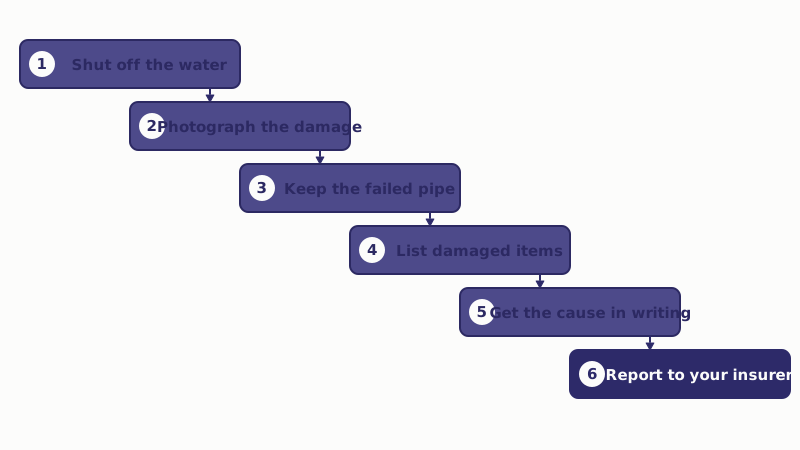
A short checklist:
- Shut off the water at the main, and drain the line. Our burst water pipe page has the first-ten-minutes steps.
- Photograph the pipe, the source and the damage before anything is moved.
- Keep the failed pipe section if you can. A plumber or an adjuster may want to see it.
- List damaged belongings with ages and costs, and keep the packaging or receipts if you have them.
- Ask the plumber to put the cause, location and repair in writing on the invoice.
- Report the loss to your insurer, and ask for the claim number and the adjuster's name.
Do not toss wet carpet, drywall or furniture until the insurer has seen it or told you that you may, unless it is a health hazard. Photos are not always enough.
Can a plumber help with the claim?
A plumber can write up what they found and fixed. Ask for an invoice or a short report that gives the date, the location of the failure, the cause as far as it can be known, and what was replaced. A plain description of a sudden burst helps an adjuster. A plumber does not decide coverage, and we can't promise how a claim will go.
Ask for the damaged section to be kept. If the pipe failed from age or corrosion, the report may show that, and the insurer may treat it differently from an impact or a sudden failure. That is why the details matter, and why it is worth being honest about the cause.
If you need a plumber now, we'll arrange a local plumber to visit. Use the quote page, and tell us the pipe is part of an insurance claim so the visit can include the paperwork you need. For a straightforward comparison of repair prices before you decide whether to claim, see our leak detection and leak repair cost guide.
What if I rent or live in a condo?
If you rent, your landlord's policy covers the building, and your renters policy, if you have one, covers your belongings. Report the burst to the landlord or manager in writing at once. If you own a condo, the association's master policy and your own policy split the building and unit, and the split depends on the association's documents. Ask the association what its policy covers.
In a multi-unit building, the source of the water matters. A burst in a shared riser is usually the building's matter. A burst in a pipe that serves only your unit may be yours. A plumber's written note of where the break was can settle the question.
LADWP has a separate billing adjustment for underground leaks on a home's own property. It is not insurance and it does not cover leaks from sprinklers, water heaters, faucets, toilets or pool equipment. The request must be made within 12 months of the leak and LADWP honors one such request in 24 months.
Common questions
How long does a plumber take on an insured burst pipe repair?
A repair on an exposed pipe is often a few hours. A burst in a wall, ceiling or slab takes longer, because surfaces must be opened and later closed. Your insurer may need to see the damage first, which can add days. Take photos before work starts and tell the adjuster when the plumber is coming so nothing is lost.
What should I ask before I hire someone for a claim-related plumbing job?
Ask whether the invoice will state where the pipe failed, why it failed as far as anyone can tell, and what was replaced, since an adjuster may read it. Ask if the failed section will be kept for inspection. Look up the CSLB record at cslb.ca.gov first, and remember a deposit above $1,000 or 10 percent of the price breaks California's limit.
Does someone need to be at the property?
Be there, or have a trusted adult present. The plumber needs access and your sign-off on the scope, and an adjuster may want to look at the pipe and the damage together. Renters may need the landlord's permission. Ask each visitor how long they plan to stay, so the visits do not collide.
Will filing a claim raise my premium?
We can't say for your insurer. Companies treat claims differently, and some record inquiries as well as filed claims. Ask your agent how a water damage claim of your size would be treated before you decide. If the repair costs less than your deductible, a claim may not pay out anyway.
Does insurance pay for the pipe itself?
Usually not. Most policies treat the failed pipe as maintenance and pay for the damage the water did, not the part that broke. Some policies pay for the cost of tearing out and replacing materials to reach it. The wording of your own policy decides, so ask the insurer which parts of the job it would cover.