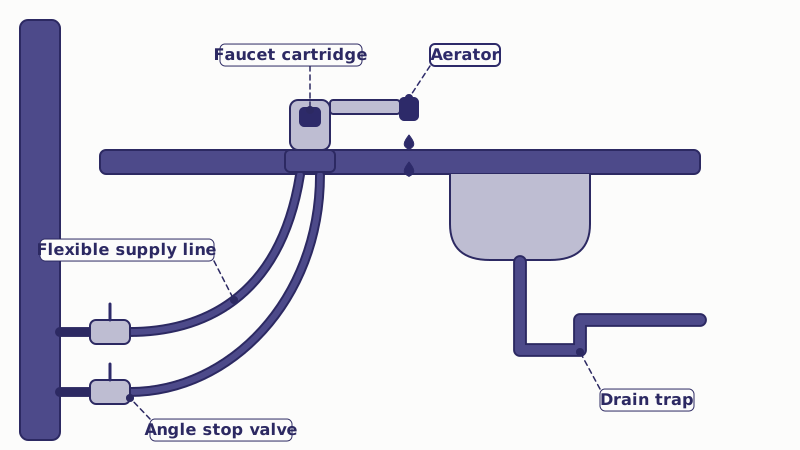
Check the aerator first. A bathroom faucet aerator is the smallest and most easily clogged part in the house, and a California bathroom faucet is meant to run slowly: the green building code caps residential lavatory faucets at 1.2 gallons per minute at 60 psi. If the aerator is clean and flow is still weak at one sink only, the fault is in that faucet or its stop valves. If every fixture is weak, read our guide on low pressure across the house. This page belongs to our coverage of faucets, sinks, showers and disposals.
Why is the water pressure low at my bathroom sink?
Usually because the aerator is clogged or the fixture is designed for low flow. California limits residential bathroom faucets to 1.2 gallons per minute, and sets a floor of 0.8 gallons per minute at 20 psi, so a trickle that looks weak may be a compliant fixture. A true problem shows as flow that has dropped or is lower than at other sinks.
Compare against yourself. If flow was stronger last month, something has changed: scale or grit has collected, a stop valve has been bumped, or a supply line has kinked after someone reached under the vanity. If you just moved in and every bathroom faucet seems gentle, the fixtures are probably doing what the code asks.
Bathroom faucets also tend to be the first to show a slow trickle, because the aerator openings are small and the supply tubes are narrow. Pop-up drain parts and stoppers do not affect pressure, so ignore those.
Why is only one bathroom sink weak when the rest of the house is fine?
Because the restriction is between that sink's stop valves and the spout. The likely items are a clogged aerator, a partly closed stop valve, a pinched supply line, or debris in a cartridge or in the hot and cold inlets of the faucet. Whole-house causes, such as the main valve or a pressure regulator, would affect other fixtures too.
Work backward from the spout:
- Remove the aerator and look. Rinse it, soak it in vinegar, and run the faucet without it for a few seconds.
- Open the stop valves under the sink fully. Turn them counterclockwise until they stop. They are often left half closed after a repair.
- Look at the flexible supply lines for a kink, and replace any with cracked sleeves or corrosion at the nut.
- Disconnect each supply at the faucet and flow it into a bucket. Strong flow means the supply is fine and the faucet is the problem.
If the faucet has hot and cold on separate handles, test each side. Weak hot only often points at the hot stop valve or at scale in the water heater plumbing. Our guide on low hot water pressure goes deeper.
How do I clean a bathroom faucet aerator the right way?
Unscrew it with your fingers or with a cloth-wrapped pair of pliers, then take it apart and lay the pieces out in order. Brush out grit, then soak the screen, washer and body in white vinegar for an hour to dissolve scale. Rinse and reassemble. If any pieces are torn or crumbling, replace the aerator with one that carries the same thread and flow rating.
Some aerators are hidden inside the spout, called cache or hidden aerators. They need a small plastic key, which often ships with the faucet and is easy to lose.
Los Angeles water varies by neighborhood. LADWP's FAQ lists average hardness of about 8.6 grains per gallon in the San Fernando Valley and Western Los Angeles, 9.8 in Silver Lake, Downtown and South Los Angeles, and 16.3 in Eastern Los Angeles and the Harbor. The harder your supply, the faster aerators scale up. If you live in the harder zones, expect to clean them every few months.
Could the pressure regulator or the whole supply be the cause?
Yes, if several fixtures are weak. A pressure-reducing valve near your main line brings street pressure down to a safe level. The California Plumbing Code requires one where static pressure would exceed 80 psi. If the valve fails or is set too low, every fixture suffers, and the bathroom shower and sink are the first you notice.
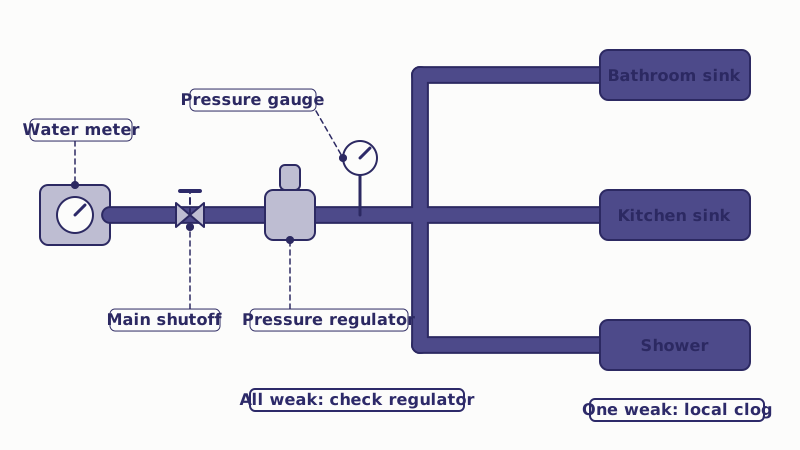
A hose-bib pressure gauge tells you quickly. Normal is roughly 40 to 80 psi. Under 40 feels weak, and a plumber should check the regulator and the main valve. Our page on the water pressure regulator explains testing and replacement. Also read why water pressure drops in a home if more than one fixture is affected.
What if flow got worse after I used a water softener or cleaner?
Softened water can clear old scale, and that scale ends up in your aerators. LADWP's FAQ warns that softening can cause existing deposits to break loose and clog washing machine inlet screens, showerheads and faucet aerators. If your bathroom sink weakened shortly after a softener went in, remove the aerator and clear it. Repeat after a few days.
The same can happen after a street water main repair or a plumbing job in the house. Debris stirred up in the line collects at the nearest small screen. A flush of each faucet, with the aerator off, for a minute, clears most of it. If the sink also has a cartridge, the cartridge screens can clog too.
When should I call a plumber for a weak bathroom faucet?
Call a plumber when cleaning the aerator, opening the stops and flushing the lines do not help, when the stop valves are stuck, when more than one fixture is weak, or when the supply lines run through corroded galvanized pipe. Plumbers can measure pressure and flow at the meter, at the regulator and at the fixture to find where it is lost.
Replacing a bathroom faucet or its stop valves is within reach for many people, but the same work in a wall-mounted or hard-to-reach setup is not. See what faucet installation costs for a guide to price. To book, ask for a written quote and we'll arrange a local plumber to come to you. Our neighbor page on low pressure at the kitchen sink covers the kitchen version of this problem.
Common questions
Why is my bathroom faucet pressure low but my shower is fine?
The faucet has a restriction the shower does not: usually a clogged aerator, a partly closed stop valve or a kinked supply line. The shower and faucet share the same house supply, so a healthy shower tells you the main line and regulator are fine. Fix the aerator and stops first.
Is 1.2 gallons per minute normal for a bathroom faucet?
Yes. The California green building code limits residential lavatory faucets to 1.2 gallons per minute at 60 psi, with a minimum of 0.8 gallons per minute at 20 psi. A new bathroom faucet that feels gentle is working as designed. If flow is lower than that, look for a clog.
Can I remove the aerator to get more pressure?
You can, and flow will rise, but you lose the splash control, and the faucet may no longer meet the flow limit that applies to new fixtures. Removing it is useful as a test: strong flow without it proves the aerator was the problem. After testing, clean it and put it back.
What does it cost to fix low pressure at a bathroom sink?
Cleaning an aerator costs nothing. A stop valve and supply line replacement involves a few parts and a short visit. A faucet replacement costs more, and repiping costs the most. Our faucet cost guide gives ranges, and you should get a written quote before work starts.
Does low pressure at one faucet mean a leak?
Not usually, but it can. A leak upstream of the faucet, in the supply line or a stop valve, can reduce flow. Look for dampness under the vanity, a musty smell or a rising water bill. If you find any of these, shut the stop valves and call a plumber.