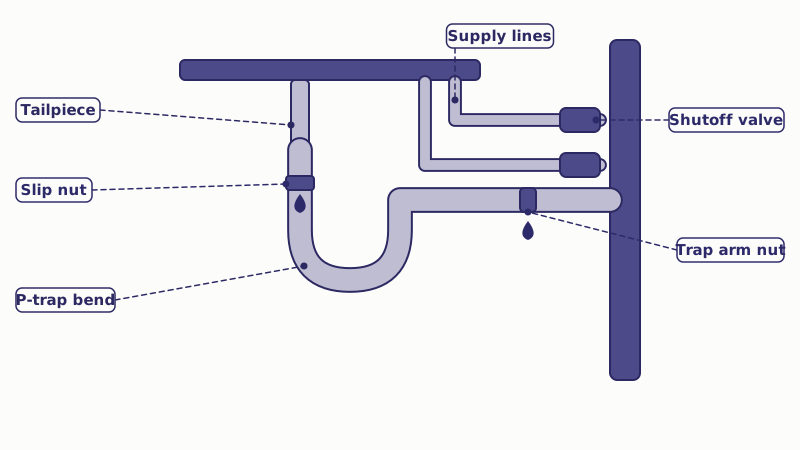
A pipe leaking under the sink usually comes down to one of three parts: a slip nut on the drain trap that has worked loose, a worn washer inside it, or a supply line or shut-off valve that is weeping at its fitting. Dry everything, run the water, and the leaking joint shows itself in a minute. This page covers faucets, sinks, showers and disposals, so we start with the fixes you can do yourself, then the signs that mean a plumber should take over.
How do I find which pipe under my sink is leaking?
Empty the cabinet, dry every pipe and fitting with a towel, put a bucket under the trap, then run the faucet for a minute. Wrap a dry paper towel or tissue around each joint in turn. The first one that gets wet marks the source. Check from the top down, because water runs downhill and fools you.
Work in this order:
- Supply lines and shut-off valves (the thin lines from the wall to the faucet). Drips here show up while the faucet is off and the valves are open.
- The faucet base and connections above the cabinet floor. Water that runs down a supply line looks like a leak lower down.
- The drain trap (the U or J shaped bend). It only leaks while water is draining, so fill the basin a few inches and release it.
- The garbage disposal and dishwasher connections, if you have them. A disposal that drips from its side seams usually needs replacing, not tightening.
- The wall or floor opening, where the drain enters the wall. A wet spot here can mean the leak is behind the cabinet.
Take a photo of the wet joint before you touch anything. It helps if a plumber ends up looking at it later.
How do I stop the leak right now?
Close the small shut-off valve under the sink on the leaking line by turning it clockwise until it stops. If the valve is stuck, drips, or there is none, close the main valve where water enters the house and open a faucet elsewhere to relieve pressure. Then set a bucket under the leak and dry the cabinet.
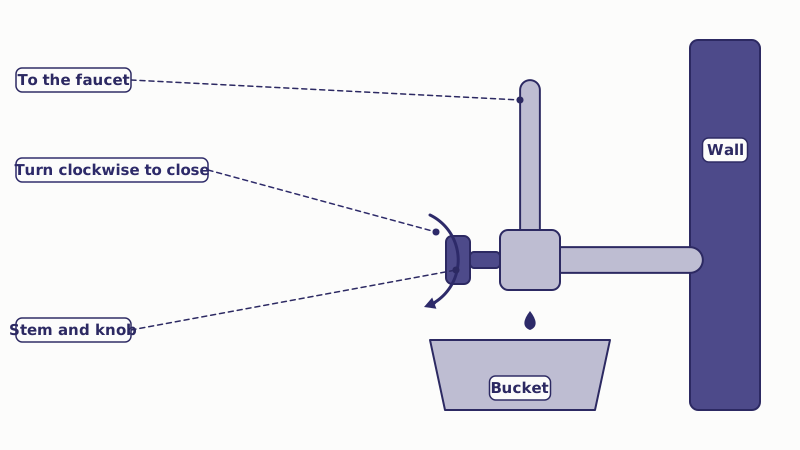
Valves that have sat untouched for decades can seize or break. Turn them slowly. A valve that stays open or spurts water when you try to close it needs replacing, and you can read what that costs on our shut-off valve replacement cost page.
If you cannot stop the flow at all, that is an emergency. Water that keeps running can soak the floor, the cabinet and the room below. Our emergency plumber page explains what to have ready when you ask us to arrange a visit.
How do I fix a leaking P-trap or drain pipe?
Hand-tighten the slip nuts on either end of the trap first. If it still drips, give the nut about a quarter turn with pliers, no more. If water keeps coming, take the joint apart and replace the rubber or plastic washer inside. A cracked nut or trap means replacing the trap itself, which is a cheap part.
Step by step:
- Put a bucket under the trap and unscrew the two slip nuts. Slide them back along the pipe.
- Pull the trap away. Pour the water in the bucket.
- Look at the washer. If it is hard, flattened, split or missing, replace it. Take the old one to a hardware store to match the size.
- Seat the new washer with the tapered side toward the fitting, which is the way most kits show it. Follow the picture in your kit if it differs.
- Line the pipes up straight, hand-tighten, then snug a little with pliers.
- Test by filling the basin a few inches and releasing it. Check each joint with a fresh tissue and look again after several minutes.
Over-tightening is the common mistake. White plastic nuts crack when you lean on them with pliers, and then you have a bigger leak than you started with.
Brass and chrome traps in older Los Angeles kitchens corrode from the inside. If the metal looks thin, pitted or green, replace the whole trap with a new kit. Do not wrap tape around a pinhole in a drain pipe: it holds for a day.
How do I fix a leaking supply line or shut-off valve?
If the drip is at a supply line connection, close the shut-off valve, then tighten the nut a little. If it still leaks, replace the flexible supply line. They are cheap, and they wear out. A valve that leaks from its stem can sometimes be fixed by gently tightening the packing nut. A valve that leaks from the body must be replaced.
Supply lines last a limited time, and braided stainless lines can fail at the crimp where the nut meets the hose. If your line is old, swollen or rusty, replace it even if it is only damp. Always shut off the water first, and open the faucet to drain the line before you unscrew anything.
Replacing a shut-off valve means cutting into the copper or galvanized pipe behind it. That is where most homeowners should stop. Galvanized supply pipe in older LA houses can be rusted inside and snap when twisted. If you see rust streaks, flaking or a green crust on the pipe, call for help before you put a wrench on it. Our page on galvanized pipe replacement shows what that path looks like.
What if a pipe has burst under the sink?
A burst pipe under a sink is a spray or a steady stream, not a drip. Close the sink's shut-off valve or the main valve right away, turn the water off at the source, and mop up. A split in a supply line or a pipe is not a repair for tape, putty or a clamp: the section has to be replaced.
After you have shut the water off:
- Move everything out of the cabinet and dry the cabinet floor.
- Run a fan and open the cabinet doors. Wet particle board swells and grows mold quickly.
- Photograph the damage for your records, including the burst section.
- Check the ceiling below if the sink is on an upper floor. Our guide on water spots on the ceiling covers what to look for.
If you cannot tell where the water is going, read how to tell if a pipe has burst. When the pipe is inside the wall, or the water will not stop, use the emergency burst pipe page.
How much does a plumber charge to fix a leak under a sink?
Published price guides put a plumber's fee for an easy-to-reach leak under a kitchen sink at about $150 to $500. A P-trap replacement alone is often listed at $150 to $250, and replacing sink drain pipes at $100 to $350. These are a guide only. The written quote you get before work starts is the real price.
What moves the price up:
| Factor | Effect on the price |
|---|---|
| A garbage disposal in the way | More time to disconnect and reconnect |
| Corroded or seized fittings | Parts and extra labor |
| Hard-to-reach pipes or a tight cabinet | More labor time |
| Water damage behind the cabinet | Separate repair, often much higher |
| A leak inside the wall | Published guides list $500 to $5,000 or more |
A service call fee is usually part of the price, and our service call cost page explains how that is normally billed. For the broader picture see plumber cost.
Do I need a permit to repair a pipe under my sink?
Tightening a slip nut or replacing a washer is a repair, not new plumbing, and generally does not need a permit. Replacing a fixture or drain piping can. The Los Angeles Department of Building and Safety lists replacing plumbing fixtures among its express permits, so ask LADBS or the plumber who comes to you before you replace more than a washer.
This page cannot tell you whether your specific job needs one, and we will not guess. The LA County exemption list, which follows similar code, treats clearing stoppages and repairing leaks as exempt when no pipes, valves or fixtures are replaced or rearranged. The City of Los Angeles has its own rules, so check with LADBS (ladbs.org) for your address.
When should I call a plumber instead of fixing it myself?
Call a plumber when the leak keeps coming back after you tighten and replace the washer, when pipes are corroded, when the leak is in the wall or floor, or when the water will not shut off. We'll arrange a local plumber to come to you and give a written quote before any work starts. Request one on our quote page.
Other signs the job is beyond a wrench:
- Water stains on the ceiling below, or a musty smell in the cabinet.
- A faucet or valve that is so old you cannot find parts.
- Low pressure at the faucet along with the leak, which may point to a failing valve or corroded line. See low water pressure in the kitchen sink.
- A sink that also drains slowly. Fix the leak first, then try our slow draining kitchen sink steps.
You can also look back at our home page for the other jobs we arrange across Los Angeles.
Common questions
How long does it take to fix a leaking pipe under the sink?
A washer swap or a trap tightening takes under an hour if you work calmly. A plumber replacing a P-trap or a supply line usually needs about an hour, longer if fittings are seized or the disposal has to come off. A leak behind the wall takes longer because the plumber must open it up and trace it.
Can I use plumber's tape or epoxy on a leaking pipe?
Tape and epoxy are for a temporary hold at best. Plumber's tape (PTFE) is for threaded joints, not for stopping a crack. Epoxy putty can slow a pinhole in a drain pipe until you replace it, but it will not hold on a split supply pipe under pressure. Replace the section instead.
What should I ask before I hire a plumber for a sink leak?
Ask for the price in writing before work starts, what is included, and whether parts are new. Ask if a permit is needed in the City of Los Angeles and who pulls it. Ask what happens if the leak returns. We'll arrange a visit and a written quote through our quote page.
Does someone need to be at the property?
Plan to be there so you can let the plumber in, show the cabinet and approve any extra work. The plumber needs clear access, so empty the cabinet first. If you cannot be there, tell us when you ask for the visit and we'll sort out an arrangement with you.
Is a leak under the sink an emergency?
A slow drip into a bucket can wait for the next available visit. Treat it as an emergency if the water will not shut off, is spraying, is reaching electrical outlets or has soaked the floor. Shut the water off, keep clear of wet outlets, and ask for a same-day plumber. Never touch electrics standing in water.