Shower valves leak for the same reason faucets do: a seal wears out. In a single-handle shower, replace the cartridge. In a two-handle shower, replace the stems or the washers and seats inside them. You turn off the water, remove the handle and trim, pull the part, fit the new one and test it. That runs from 30 minutes to a couple of hours. For neighboring repairs, see our hub on faucets, sinks, showers and disposals, and read on for the order of steps and the warnings.
Is it the showerhead, the valve or a pipe in the wall?
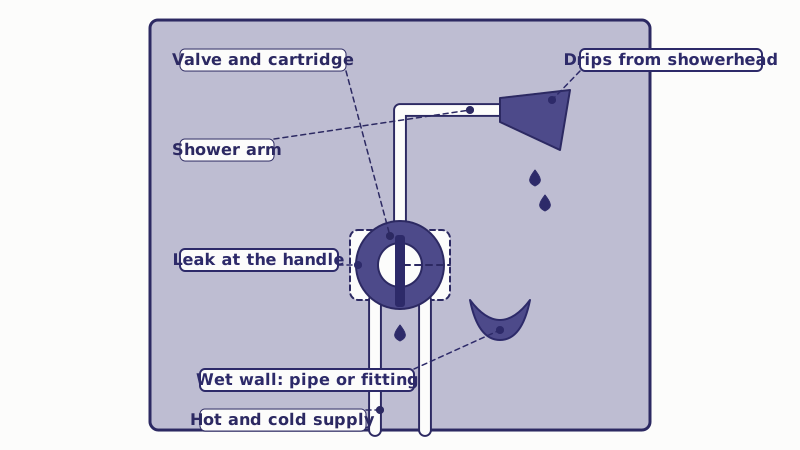
Look at where the water emerges. A drip from the showerhead after you turn off the handle is usually the valve, and sometimes only a worn showerhead washer. Water at the handle or trim plate is a valve seal or loose part. Water on the wall, ceiling or floor next to the shower points to a pipe or fitting behind the wall.
A showerhead dripping after shutoff can also be left-over water in the arm, which should stop in under a minute. A drip that continues for hours is not. EPA WaterSense says a showerhead that leaks at ten drips a minute wastes more than 500 gallons a year, so it is worth stopping even though it looks small.
Quick test: after you shut the shower off, watch the showerhead for ten minutes. A steady drip after that is the valve, not left-over water.
How do I fix a leaky single-handle shower faucet?
Replace the cartridge. Shut off the water, then pry off the handle cap, unscrew the handle, and remove the trim plate and the metal stop tube if there is one. Pull the retaining clip or nut, then pull the cartridge out, using a puller tool when it is stuck. Match the new one to the old one, grease the O-rings, and reinstall it facing the same way.
Most single-handle showers use a pressure-balancing cartridge that keeps temperature steady when someone flushes a toilet. Do not substitute a standard cartridge, and do not skip the plastic stop tube or the rotation limit stop. These control how far hot can turn, and a wrong setting can scald. Adjust the limit according to the manufacturer's instructions and test the water temperature afterward, and keep your water heater thermostat at a safe setting.
Brand matters, since shower fixtures are not interchangeable between makers. Delta, Moen, Kohler, American Standard and others each use their own cartridge, and some have repair kits that include the right seals. Search for the brand and model on the manufacturer's support page and follow their parts diagram, rather than buying from a generic wall of cartridges.
How do I fix a leaky two-handle or double-handle shower?
Each handle controls a stem with a rubber washer or a ceramic disk. Find which side leaks: if hot drips, work on the hot stem. Shut off the water, pull the handle, unscrew the escutcheon, and use a deep socket or wrench to remove the stem. Replace the washer and seat or the full stem, and reassemble.
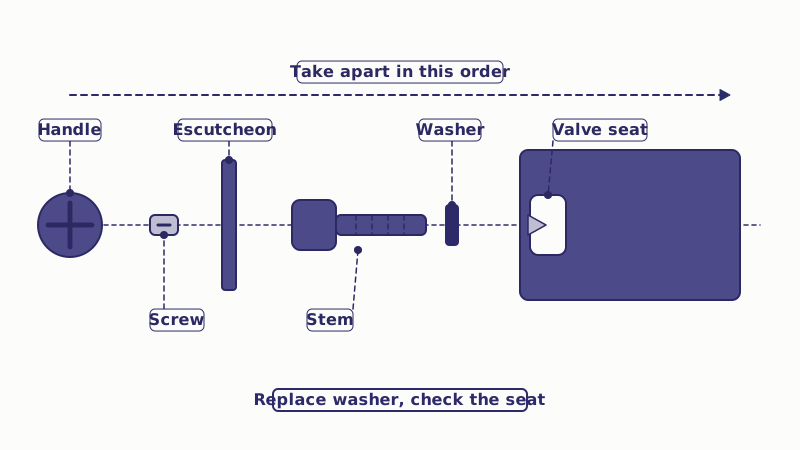
If the stems are brass compression types, the washer is the usual problem. If the old stems have a ceramic disk, replace the whole stem. Stems from the same brand may look alike but have different thread counts, so bring the old one to match it. A three-handle shower adds a diverter stem, with a similar swap.
When stems are corroded, and you strip the nut or rounded the splines, stop. Forcing it risks cracking the valve body, which sits inside the wall and turns a small repair into a tile job.
Do I need to shut off the water, and where is the valve?
Yes, always. Some showers have small stops behind the handle or trim, and a few have an access panel in the next room. Many older Los Angeles homes do not, so you use the main shutoff where the line enters the house, which is usually at the front near the meter or hose bib. Open a lower faucet to drain the lines, then work.
Know where the main valve is before you start, and test it. Old gate valves can seize or fail to close fully when turned after decades. If yours does not close fully, water keeps flowing when you pull the cartridge. In that case, do not try to force the cartridge out. Stop and call a plumber.
When is a leaking shower an emergency or a job for a plumber?
Call a plumber when you see water stains on the wall or ceiling near the shower, when a drip persists after a new cartridge, when the valve body is cracked, or when the tile and wall are soft. A slow leak inside a wall causes mold and rot that cost far more than the repair. Plumbers also locate pipe leaks in the wall without demolition using pressure testing and moisture meters.
If the leak is a pipe joint in the wall, repair means opening the wall. Our page on plumbers for shower leaks explains what to expect. In California, a job of $over $1,000 once labor and materials are added, or one requiring a permit, needs a contractor with a C-36 plumbing license, so a wall-opening repair falls on the professional side.
If the shower also runs cold or hot only, our guide to a shower with no hot water covers that separately. If the water is weak rather than leaking, see low shower water pressure.
What if the shower leaks only when it is running?
That points to a leak between the valve and the showerhead: a loose arm, a worn arm threads, or a failing joint behind the wall. Wrap the threads of the shower arm with Teflon tape and retighten the showerhead first. If the wall is wet only while the shower runs, the leak is on the downstream side and needs a plumber to open and inspect it.
Check the shower arm elbow where it enters the wall. Many are held by a drop-ear elbow with screws, and the joint can loosen over time. If the escutcheon has a gap, a thin bead of silicone can stop water entering the wall but does not fix a leak inside it.
How much does it cost to fix a leaking shower faucet?
If you do the work, a cartridge or stem kit runs from a few dollars to around the price of a brand-name cartridge. Hiring it out adds labor, which varies by access. A plumber can usually swap a cartridge within a visit, but a valve replacement involving the wall costs more. See what faucet work costs for a guide, and ask for a written quote.
Common questions
Why does my shower keep dripping after I turn it off?
A worn cartridge or stem is the usual reason, because it no longer seals fully. Hard water scale can also hold a seal open. LADWP says its water ranges from roughly 5 to 17 grains per gallon, so mineral buildup is common. Replace the cartridge, and if it drips again within weeks, the valve seat may be pitted.
How do I fix a leaky Delta shower faucet?
Find the model or series number, then buy the matching Delta cartridge or repair kit from Delta or a retailer that lists the match. Shut off the water, remove the handle, bonnet and cartridge, fit the new one with fresh grease, and reassemble. Delta's own instructions show each series, so follow the diagram for yours.
Can I fix a leaky shower faucet myself?
Often yes, if you can shut off the water, take the handle off and match a part. It is a good first plumbing repair. Do not do it if the valve is seized, the stems are corroded, or you see signs of a leak inside the wall. At that point the job is a plumber's.
How long does a shower faucet repair take?
A cartridge swap typically takes 30 to 90 minutes. A two-handle repair with a stuck stem can take longer. Valve replacement behind tile can take most of a day, because the wall must be opened, the valve soldered or joined, and the wall closed again.
Does a leaking shower raise the water bill?
Yes. EPA WaterSense says a showerhead leaking ten drips a minute wastes over 500 gallons a year, and a faster drip wastes more. A leak you cannot see is worth ruling out if the bill is up. Compare your meter reading before and after a two-hour period with no water use.