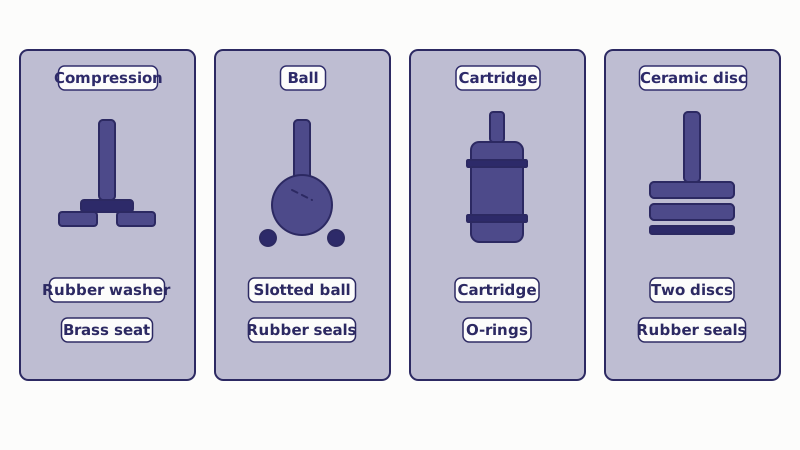
To fix a leaky faucet, shut off the water to it, take the handle off, and replace the worn part inside. What that part is depends on the faucet's design: a rubber washer in a compression faucet, a cartridge in most single-handle faucets, a set of springs and seats in a ball faucet, or a ceramic disk cartridge. Most repairs cost a few dollars in parts and take under an hour. This guide sits within our wider coverage of faucets, sinks, showers and disposals.
What kind of faucet do I have?
Look at the handles. Two handles that you turn several times and that stop firmly are usually compression faucets. Two handles that turn only a quarter turn are ceramic disk. One handle that moves a ball-shaped lever over a round body is a ball faucet. One handle that lifts and swings is a cartridge faucet. The type decides the repair, so identify it before you shop.
| Type | How it looks and feels | What wears out |
|---|---|---|
| Compression | Two handles, several turns to shut | Rubber washer, seat, packing |
| Cartridge | One or two handles, smooth action | Cartridge, O-rings |
| Ball | One handle over a domed cap | Springs, seats, O-rings, ball |
| Ceramic disk | Quarter-turn handles or one handle | Whole disk cartridge |
If you are not sure, take the handle off (steps below) and photograph what is inside, or take the handle and the old part to a hardware store. Brand names matter for cartridge parts. Delta, Moen and others publish parts diagrams by model, and a close but wrong cartridge will not seal.
How do I stop a leaky faucet, step by step?
Turn off the water at the stop valves under the sink, or at the main if there are none, and plug the drain so small parts cannot fall in. Open the faucet to drain pressure. Remove the handle, take out the worn part, match it exactly at a store, fit the new part with a smear of plumber's grease and reassemble. Turn the water on slowly and test.
In more detail:
- Look for a decorative cap on the handle, usually marked hot or cold. Pry it up gently with a small screwdriver.
- Remove the screw under it and lift off the handle. If it sticks, a handle puller helps. Do not hammer.
- Under the handle is a bonnet nut or a retaining clip. Unscrew or pull it, protecting the finish with a cloth.
- Pull the stem or cartridge straight out. Note which way it faces.
- Replace the worn parts, in order: the washer or cartridge, the O-rings, and the seat if it is scored.
- Reverse the steps. Open the faucet before you turn on the water fully to let air out.
Take a photo at each step, as fixtures differ more inside than outside, and keep the old parts in order on a towel. You need a screwdriver, an adjustable wrench, pliers and a rag, and sometimes a hex key.
Why is my faucet dripping from the spout?
Because a seal inside no longer closes fully. In a compression faucet the washer hardens and the seat wears. In a cartridge or ceramic faucet the cartridge or its O-rings are worn, or grit holds the seal open. Hard water scale also contributes. LADWP reports hardness from roughly 5 to 17 grains per gallon in different parts of its service area, and says hard water leaves deposits in plumbing.
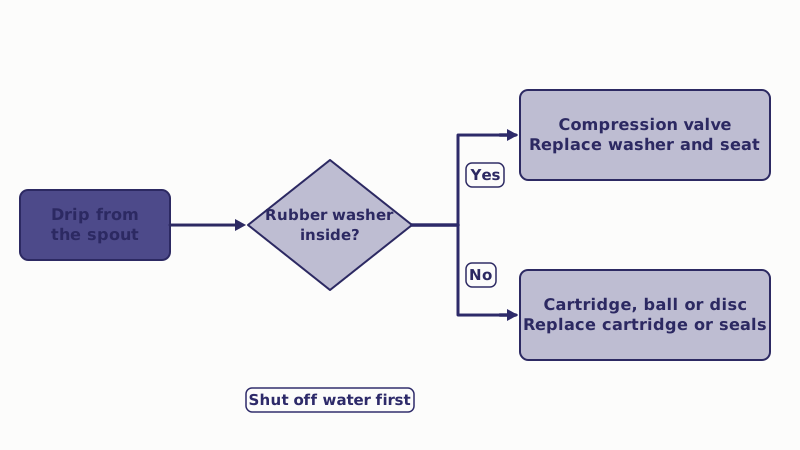
EPA WaterSense says a faucet that drips once a second wastes more than 3,000 gallons a year, and that worn washers and gaskets are frequent causes. A drip is worth stopping early. If you replace the parts and it still drips, the seat or the valve body is damaged and the faucet should be replaced.
Our page on fixing a leaky kitchen sink faucet goes deeper on one-handle and two-handle kitchen models, bathroom sink faucets included.
Why is water leaking around the handle or the base?
The seals around the stem, the bonnet or the spout have worn. A leak at the handle only when water is running is a packing nut, packing washer or stem O-ring. A leak at the base of a swivel spout is the spout O-rings. Tighten the nut a little first, and if that does not stop it, replace the rings and the packing.
On a pull-down faucet, a leak under the sink may be the hose connection or a cracked sprayer line, not the faucet at all. Dry everything, press a paper towel against each joint and watch for the wet spot. If the water is coming from a supply line or a stop valve, see repairing a leaking pipe under the sink.
How do I fix a leaky bathtub, shower or outdoor faucet?
The method is the same, with different access. For a tub, a one-handle valve has a cartridge and a two-handle valve has stems and washers, and both are reached through the handle and trim. Our guides cover a leaky bathtub faucet and a leaky shower faucet. For the outdoor spigot, see a leaky outdoor faucet.
Outdoor faucets add a vacuum breaker, a backflow device that stops hose water running back into the house supply, and sometimes a long frost-free stem. Do not remove a vacuum breaker with a large wrench. Tub and shower valves are usually in a wall, so a seized stem or a hidden valve body may call for a plumber.
What about hard water, Delta faucets and stuck handles?
Hard water makes parts wear and stick, so soak removed parts in white vinegar to dissolve scale before you reuse them. For a Delta, find the series number and buy the matching Delta repair kit, because Delta uses several designs. For a handle that will not come off, a handle puller works better than force. See removing hard water scale for the full method.
Hardness differs across the city, and faucets in harder-water areas are likely to need new parts sooner.
When should I call a plumber?
Call a plumber when a drip returns after new parts, when parts will not come off, when the faucet or its mounting is corroded, when you see damp or stains behind the fixture, or when the leak is inside a wall. Older Los Angeles houses with galvanized pipe and original stop valves often need the stops replaced at the same time.
If a faucet is beyond repair, replacement is a short job, and our guide to faucet installation costs gives price ranges. To book a visit, ask for a written quote and we'll arrange a local plumber to come to you. A faucet leak may also add to your bill, so see why a water bill gets high.
Common questions
Can I fix a leaky faucet myself?
Usually, yes. It needs a few hand tools, the right parts and about an hour. You must be able to shut off the water and identify the faucet type. If the water will not shut off, the handle will not come off or the leak is inside a wall, hand the job to a plumber.
What is the most common cause of a leaky faucet?
A worn rubber washer or O-ring or a worn cartridge. EPA WaterSense names old, worn washers and gaskets as frequent causes of faucet leaks. Scale from hard water, which is common in Los Angeles, speeds up this wear and can score the seat.
How do I fix a leaky faucet with two handles?
Work out which side leaks, shut off the water, remove that handle and the bonnet nut, pull the stem and replace the washer and O-ring, or the whole stem if it is a ceramic disk type. Match parts to the old ones. If a new washer does not stop it, the seat is worn and needs resurfacing or replacement.
How do I fix a leaky faucet that is outside?
Check where it leaks. A drip from the spout is a worn washer. Water behind the handle is a packing nut, and tightening it a quarter turn often fixes it. A leak from the cap near the top is the vacuum breaker, which is replaced, not repaired. Water in the wall needs a plumber.
How much does it cost to fix a leaky faucet?
Parts are usually a few dollars for washers and O-rings, and more for a brand-name cartridge. A plumber's labor for a repair is priced near a service call, and a replacement faucet costs more. See our faucet cost guide for published ranges, and ask for a written quote.