Shut off the water at the main, then have a plumber find where it is escaping. A leak in a supply line, a drain, a fixture or under the slab each needs a different fix, and guessing wastes money. We arrange a local plumber who comes to your home, locates the leak and gives you a written quote before work starts. Published Los Angeles prices run roughly $150 to $400 to locate a hidden leak and $2,000 to $6,000 for a typical slab repair, with simple fixture leaks far cheaper. For the wider picture, start on the plumber home page.
What should I do first if my water pipe is leaking?
Turn off the water at the main shutoff valve, then open one low faucet to relieve pressure. Move anything the water could damage, switch off power to any wet area if you can reach the panel safely, and photograph the damage. Then call a plumber. If you cannot find or close the shutoff, LADWP takes water emergency calls at 1-800-342-5397.
Know where that valve is before you need it. In many homes it is a round wheel handle that corrodes and sticks, so turn it once a year to keep it free. A valve that will not close fully is worth replacing, and it is a common small job.
Once you are safe and the water is stopped, send your details through our quote page and a local plumber comes to you to find the cause.
How does a plumber find a hidden water leak in a house?
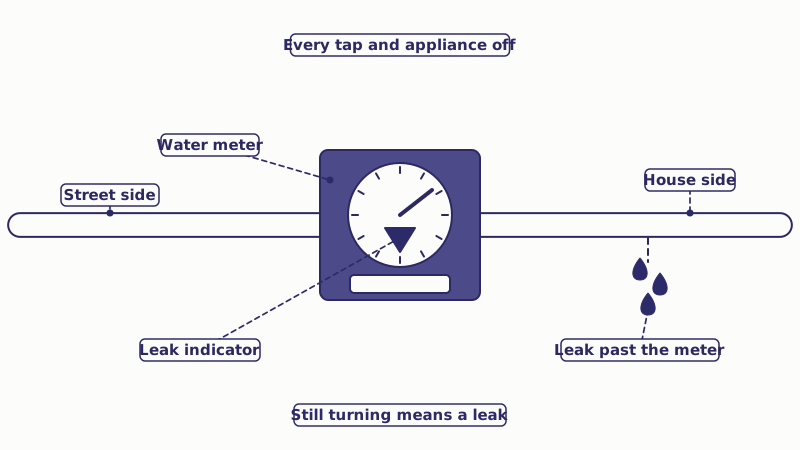
A plumber starts with a meter test, then narrows the search with listening gear, moisture meters and thermal cameras so as little wall or floor as possible is opened. You can do the first step yourself: turn off every fixture and watch the meter. If the dial still moves, water is escaping somewhere on your side of it.
The US EPA suggests reading the meter, waiting two hours with no water in use, and reading it again. Any change means a probable leak. A toilet is the usual suspect, and a few drops of food coloring in the tank will show a leaking flapper if color reaches the bowl within 10 minutes.
When the leak is out of sight, a plumber closes valves to split the house into sections and sees which section keeps the meter moving. Electronic listening devices pick up the hiss of pressurized water, even through concrete, and thermal cameras show warm patches where a hot line is leaking. Leak detection in Los Angeles is commonly quoted between about $150 and $400. Our leak detection cost guide breaks down what moves that figure.
High bills are often the first clue. If yours jumped and nothing looks wet, read why a water bill climbs without an obvious cause.
My water pipe is leaking under my house. What should I do?
Shut off the main, then work out whether the pipe sits in a crawl space or under a concrete slab. Under a raised floor a plumber can usually reach the pipe from below and repair it. Under a slab the leak is harder to reach, and the choice is a spot repair, a reroute of the line, or a repipe.
Signs of a leak under the floor include a warm patch on the flooring, the sound of running water when everything is off, a water heater that never stops cycling, damp carpet, and a meter that keeps moving. A warm patch usually points to a hot line. Other things warm a floor too, including heating ducts and a water heater close by, so a plumber confirms before opening anything.
Costs for slab work vary. Published Los Angeles prices run roughly $2,000 to $4,500 for a spot repair, $1,500 to $6,000 for a reroute through the walls or attic, and $4,500 to $15,000 or more for a full repipe. Read the slab leak repair cost guide and the comparison of slab leak repair or repipe before you accept a quote.
What kind of clamps can I use to stop pipe leaks?
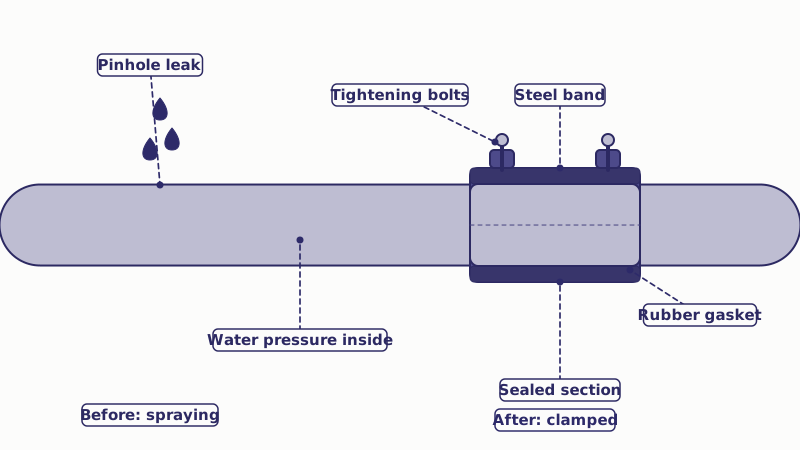
A stainless steel repair clamp with a rubber sleeve is the standard temporary stop for a pinhole or small split in a straight section of pipe. Match it to the pipe diameter, tighten it evenly, and treat it as a stopgap. It will not fix a leaking joint, a corroded fitting or pipe that is thin along its length.
Push-on couplings that slip over a clean cut pipe are a step up and last longer, but they only suit pipe that is sound around the damage. Epoxy putty and self-fusing silicone tape can slow a drip on a dry, cleaned pipe. They hold poorly under full pressure.
A clamp that needs retightening, or a second leak appearing a few feet from the first, is a warning. Pipe that leaks in more than one place is often failing as a whole. Our guides on repairing a copper pipe leak and fixing a leaking pipe joint go through the options by pipe type.
What is the most effective way to fix a leaking pipe?
Cut out the damaged section and replace it with new pipe and proper fittings. That is the lasting fix. Clamps, tape and sealants stop water for a while, but only a replaced section removes the weak point. For copper that means a soldered or press-fit coupling. For plastic it means a cut-and-couple repair.
The right method depends on the material and where the leak sits. A leaking joint can sometimes be remade. A pinhole in a copper line often means the pipe wall is thinning, so more holes may follow nearby. A leak in a wall or ceiling needs the surface opened, and drywall repair is a separate cost.
Gas piping is never a do-it-yourself job, and some water work needs a permit. The Los Angeles Department of Building and Safety requires a plumbing permit for installation or modification of potable water piping and drainage systems, so ask the plumber whether your repair triggers one. For jobs of $over $1,000 once labor and materials are added, California requires the contractor to hold a state license, and you can check any name on the CSLB website. LADBS lists the permit rules here.
How long does a plumber usually take to fix a leak?
An accessible leak on a fixture, supply line or exposed pipe is often fixed within a few hours. Leaks inside a wall or ceiling take longer because of the opening, the repair and the closing up. A slab leak can take a day or more, depending on whether the plumber repairs, reroutes or repipes.
Finding the leak is the shortest part when the pipe is visible and the longest when it is hidden, because a plumber works section by section. A reroute through the attic and walls is commonly described as a one to two day job, and a whole-house repipe can run several. Drywall, flooring and paint come afterward, often with different trades.
Ask for the timeline in the written quote, along with what is included. It should say whether drywall repair, permits and cleanup are part of the price. Nobody can promise an exact finish time before they see the pipe, so be wary of anyone who does.
Is it a burst pipe or an emergency?
Treat it as an emergency when water is flowing and you cannot stop it, when it is near electrical panels or outlets, or when a ceiling is sagging with water. A burst pipe sprays or pours rather than drips. Shut off the main, stay clear of wet electrical equipment, and call a plumber straight away.
Our pages on emergency help for a burst pipe, how to tell if a pipe has burst and what makes pipes burst cover the signs and next steps. If a leak has already reached the ceiling, see ceiling water leaks and what to do about stains that appear with no visible leak.
Insurance often matters here. A sudden burst is treated differently from a slow leak, and the details sit in your policy. Does insurance cover a burst pipe explains the usual pattern.
Common questions
What is the quickest way to fix a leaking copper pipe?
Shut off the water, dry the pipe, and fit a repair clamp or push-on coupling over the damaged spot. That stops the leak quickly, but it is temporary. For a lasting fix, a plumber cuts out the damaged section and joins new copper with a soldered or press fitting. Several leaks on one line suggest the pipe itself is wearing out.
Can JB Weld fix a copper pipe leak?
Epoxy putty can slow a small pinhole leak on a clean, dry pipe, but it is a poor choice on a line under full pressure and it will not last. Treat it as a short-term patch until a plumber replaces the section. Never use it on gas piping. A clamp or coupling is more dependable for similar money.
What do you do when your pipes burst?
Turn off the water at the main, open a low faucet to drain the line, and switch off power to wet areas if you can do it safely. Move belongings, take photographs for your insurer, and call a plumber. Do not touch electrical equipment standing in water. If you cannot close the main, call LADWP at 1-800-342-5397.
Are burst pipes expensive to fix?
The pipe repair itself is often modest, but the cost climbs with water damage, access and the number of failures. Opening a wall, replacing drywall and drying the structure can cost more than the plumbing. A slab burst costs more again. Published Los Angeles figures for slab work run about $2,000 to $6,000, and a written quote after a visit gives the real number.
How long does it take a plumber to fix a burst pipe?
A burst pipe in an accessible spot is often fixed in a few hours. A pipe inside a wall adds time to open and close the wall, and one under a slab can take a day or more. Arrival time depends on the plumber and the day, so ask for the window when you book. Nobody should promise a finish time unseen.
Will plumbers tape stop a leak?
Tape can slow a very small leak on a dry, clean pipe, and some plumbers use self-fusing silicone tape as a short-term wrap. It is not a repair. Under pressure it often fails, and it does nothing for a leaking joint. If someone suggests tape as the final fix, ask what the permanent repair would be and what it costs.