You can install a water softener yourself if you can cut and join pipe, but the law narrows it. California lets an unlicensed person do work under $1,000 only when it needs no building permit, and a softener tied to your main line probably needs one in Los Angeles. Read the limits below before you buy anything. If the job belongs to a professional, the water softener installation plumber page explains how a local plumber comes to you.
Can you legally install a water softener yourself in Los Angeles?
Only within limits. California requires a CSLB contractor license for work worth $1,000 or more, and for any work that needs a building permit, whatever the price. Contractor sources say LADBS requires a permit when a softener ties into the main line, but we could not confirm that on an official page. Ask LADBS before you start, and ask whether an owner can pull their own permit.
That leaves two safe paths. If your house already has a softener loop and you are swapping like for like, the work is smaller and may not need a new permit, but confirm that with LADBS rather than assuming. If you are cutting into the main, expect a permit and an inspection, and expect a plumber to be the easier route.
The cost of a mistake is high. A failed joint behind a wall can flood a house, and unpermitted work shows up in a buyer's inspection when you sell. A plumber who pulls the permit gives you a record. See the water softener installation cost page for what that costs.
What do you need before you start?
You need the softener and its manual, a bypass valve if the unit lacks one, fittings that match your pipe, a hose or drain tubing, a drain location, a power outlet within reach, and softener salt. You also need to know your pipe material and water pressure. Do not start until you can shut off the water at the main and it holds.
Read the manual first. Makers set limits on water temperature, pressure and clearances, and their installation instructions govern the unit. Check pipe material at the main: copper, PEX, CPVC and galvanized each need different fittings, and older galvanized lines need a plumber's eye, because cutting into corroded pipe often leads to more replacement than planned.
Count your clearance. The tank holds salt and water and gets heavy, so choose a level, sound floor with room to add salt from above. Keep it out of direct sun and away from freezing risk.
Confirm hardness too. LADWP's 2022 averages ran 8.6 grains per gallon in the Valley and western Los Angeles, 9.8 in Silver Lake, Downtown and South Los Angeles, and 16.3 in eastern Los Angeles and the Harbor. LADWP says its water is safe without softening, so you are installing for scale and comfort.
What are the installation steps?
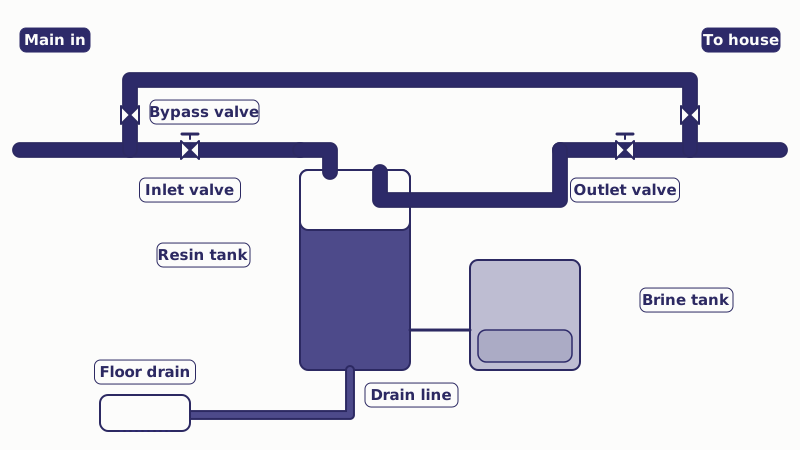
The sequence is: shut off the water and drain the lines, cut into the main after the shutoff and the pressure regulator, install the bypass and the inlet and outlet connections, mount the softener, run the drain line through an air gap, plug in the control head, set hardness and regeneration, add salt, and start a regeneration. Then open the water slowly and check every joint for leaks.
Pay attention to inlet and outlet. They are marked on the valve, and reversing them is a common mistake. Do not solder close to the plastic valve body, because heat can damage it, and take a fire precaution for soldering in a garage. Push-fit or crimp connections avoid the torch, but follow the fitting maker's instructions for your pipe.
Leave an untreated cold line for outdoor hose bibs, since Wikipedia's water softening article notes that softened water is unsuitable for irrigation. Keep the water heater downstream if you want it treated, and check the softener's maximum water temperature in the manual so hot water does not back up into the unit.
When you restore water, open a nearby faucet first to purge air, then bring the pressure up slowly. Let the control head run its first regeneration and watch the drain, then check the joints again after an hour and after a day.
How do you plumb the drain line for a softener?
The drain line carries regeneration wastewater to a sanitary drain, and it must enter through an air gap. The California Plumbing Code requires this; the City of Ventura inspection checklist cites section 611 and Table 603.3.1. The air gap stops sewage flowing back into the softener. Gap size depends on that table and your local rules, so check before you build.
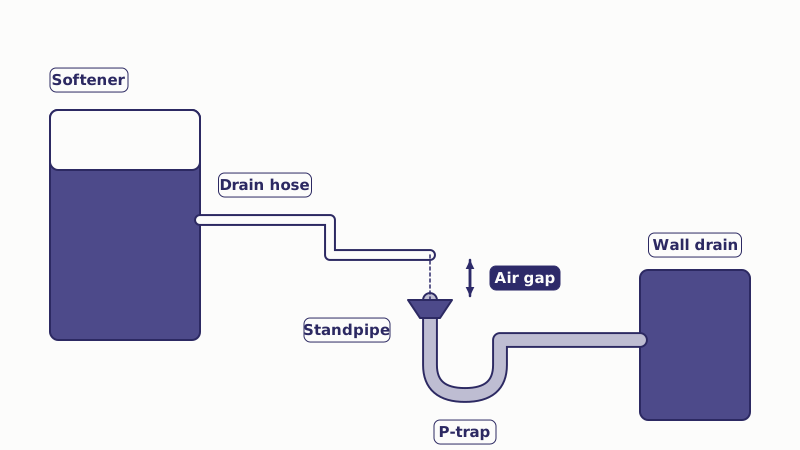
Good drain choices are a laundry standpipe, a floor drain or a utility sink. Do not tap or drill the building drain to connect the line. Do not run the drain hose straight into a pipe with a tight seal, and do not place the end below the flood rim of a sink. Secure the hose so it cannot whip during backwash.
Distance and height matter. A long run or a drain above the unit may need a pump, and that adds a part that can fail. If no suitable drain is near, that alone is a good reason to bring in a plumber.
Are salt-based softeners restricted where you live?
Some districts near Los Angeles restrict them. The Santa Clarita Valley requires removal of automatic salt-based softeners, and Newhall Ranch has an ordinance taking effect October 1, 2026. We found no such ban in the City of Los Angeles, but check the rule for your address. Under California Water Code 13148, agencies must compensate owners if they order removal.
State law limits how far local agencies can go. Health and Safety Code sections 116775 to 116795 treat residential softener use as a right that may be restricted only under set conditions. Where a ban applies, an exchange-tank service or a salt-free conditioner may be your only compliant choice.
Before buying, ask your sanitation district whether any rule covers your street. The Los Angeles County Sanitation Districts list a phone line for Santa Clarita Valley residents on their resident FAQ page.
What about removing hard water scale without a softener?
A softener prevents new scale, but it does not clear what is already in your fixtures. Soak showerheads and aerators in vinegar or citric acid, and flush your water heater, as LADWP recommends, at least once a year. For the full routine, see removing hard water scale, including what cannot be removed from inside pipes.
If scale is the only problem, you may not need a softener at all. Cleaning plus a yearly flush may be enough in a medium-hard area. If scale keeps coming back within weeks, treating the water makes sense, and whole-house water softener installation covers the full-house route.
Expect a short clean-up period after a softener goes in. LADWP warns that softening older plumbing can loosen mineral deposits and clog screens, so check aerators and washing machine inlet filters in the first weeks.
When should you call a plumber instead?
Call a plumber when there is no existing loop, when the main needs cutting and you do not do pipe work, when the drain is far or needs a pump, when your pipes are galvanized or corroded, or when LADBS requires a permit you would rather not manage. A permit-pulling plumber also handles the inspection and a written record.
A local plumber comes to you, looks at the spot and gives a written quote before work starts. You can request a quote, and how a job runs walks through the steps from first contact to the finished install. For old pipe worries first, see why water pressure runs low.
Common questions
How long does a DIY water softener installation take?
For someone who does pipework, a swap on an existing loop can take a couple of hours, and a first install with a new drain and a cut into the main can take most of a day. Allow extra time for a leak check the next day. Rushing the first fill and regeneration is how small leaks get missed.
What tools do I need?
Typical tools are a pipe cutter, tape measure, adjustable wrenches, a deburring tool, fittings to suit your pipe, thread tape, a drain hose and clamps, a bucket, a level, and a means of draining the lines. For copper you may need a torch and flux. For PEX you need the crimp or expansion tool the fittings require.
Should I install the softener before or after the water heater?
Before. The softener belongs where the main enters, so the water heater gets softened water, which helps against scale. Many makers set a maximum inlet water temperature, so do not feed hot water into the unit. Check the manual for your model.
What happens if I skip the air gap?
You risk wastewater being drawn back into the softener and your water supply if the drain backs up, and you fail inspection. The California Plumbing Code requires the air gap for a softener drain. It is cheap to build correctly and expensive to fix after a failed inspection.
Is DIY cheaper than hiring a plumber?
On paper yes. Published guides put labor at $150 to $1,000, and typically $300 to $800, so you save that, and you take on the risk. Factor in tools, a permit fee of $50 to $150 where required, and the cost of fixing mistakes. For a first-time install on the main, many owners find the plumber's quote is worth it.