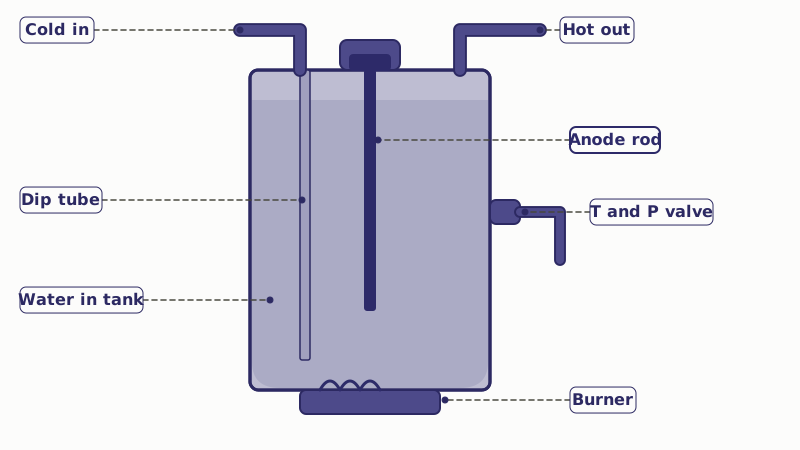
Expect roughly $150 to $350 for a plumber to replace a water heater anode rod, with the rod itself costing about $20 to $50 as a part. Those are national guide figures from published cost surveys, and the real number depends on access above the tank and whether the old rod has seized. This page also prices the small parts that sit next to it, from a water heater element to an expansion tank, so you can judge a quote line by line.
How much does it cost to replace a water heater anode rod?
About $150 to $350 installed, based on national figures published by HomeGuide. Angi's city pages show a wider spread, from roughly $50 to $150 in Chicago up to $200 to $500 in New York, so a Los Angeles quote can land anywhere in that overlap. The rod alone is $15 to $50. The rest is labor, and the difficulty of loosening it.
A rod is a metal stick, usually magnesium or aluminum, that sits inside a glass-lined tank and corrodes in place of the steel. That is why it is called a sacrificial anode. When it is used up, corrosion turns to the tank walls, and the tank is the expensive part. Our page on anode rod water heater replacement explains how the swap is done and when to do it.
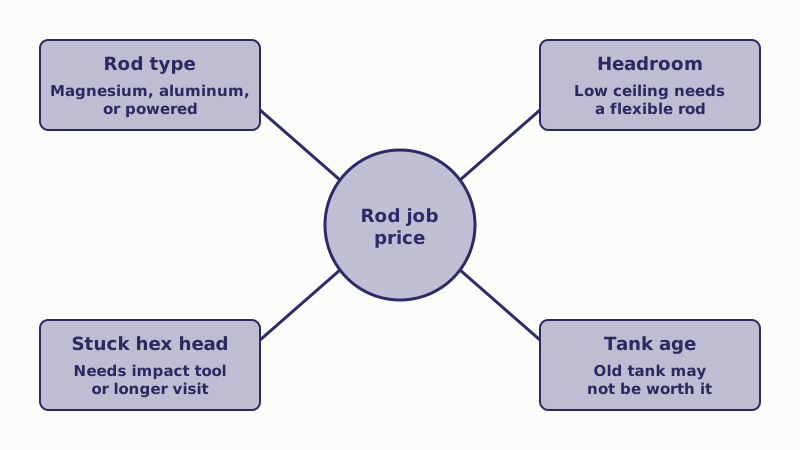
What makes an anode rod job cost more or less?
Three things: how tight the space is above the tank, how hard the rod hex head is to break loose, and whether the heater is worth fixing. A hex head that has rusted in place can take a long breaker bar or an impact wrench. A closet with a low ceiling needs a flexible rod instead of a straight one, which costs a little more.
Mineral buildup matters in Los Angeles. LADWP reports average hardness from about 8.6 to 16.3 grains per gallon depending on the area, and scale freezes a rod in its fitting. Softened water also eats a rod faster, so homes with a softener usually need it checked more often.
What do the other small water heater parts cost?
Most small parts fall in the $100 to $350 range with labor, and an expansion tank sits higher. Treat the table as a guide drawn from published figures, and expect a plumber to quote the real price after looking at your heater.
| Part | Guide range, installed | Notes |
|---|---|---|
| Anode rod | $150 to $350 | Part alone $15 to $50 |
| Heating element, electric | $100 to $350 | Angi city pages show $200 to $440 |
| Thermostat, electric or gas | $100 to $350 | Gas thermostat pages run $100 to $350 |
| Thermocouple, gas | $100 to $250 | Part alone about $10 to $30 |
| Dip tube | $100 to $350 | Falls in the same group as the other small parts |
| Expansion tank | $300 to $800 nationally | Angi gives $200 to $500 for Los Angeles |
| Relief valve, gas control valve | Ask for an itemized quote | No reliable published range found |
I did not find a published range for the pressure relief valve or the gas control valve that I would trust, so the table says so rather than guessing. A gas control valve is a larger part than a thermocouple and a plumber will quote it after testing.
Should I replace the anode rod or the whole water heater?
Replace the rod when the tank is still sound and the heater is under about ten years old. Replace the heater when the tank leaks, when it is old and the repair bill is climbing, or when scale has taken over. A $200 rod on a heater with a rusted bottom saves nothing.
Use this rule of thumb: if the repair costs more than about half of a new unit, ask for both prices. Our water heater replacement cost page lays out the new-unit side. A leaking tank is not a rod problem, and our guide to water heater leaks explains what to do when you find water on the floor.
How often should the anode rod be checked?
A manufacturer manual hosted by the Department of Energy says to inspect the rod after a maximum of three years, then every year, and every year from the start if the water is softened. It lists signs of a spent rod, such as most of the rod thinner than 3/8 inch, or a third or more of the support wire showing.
Ask the plumber to show you the old rod. Seeing it removes any doubt about whether the job was needed. If the rod is still thick and intact, it can go back in, and the visit should cost less than a replacement.
When should I call a plumber business to replace a rod or part?
Call when the heater is gas, when the fitting will not move, when the rod sits in a tight closet, or when you cannot shut the water and power off safely. Do not work on a gas control valve yourself. In Los Angeles a plumber also needs to confirm whether any part of the job changes the heater enough to need a permit.
Safety steps before any rod or part job: switch off the electric breaker or turn the gas control to off, close the cold water inlet, and open a hot tap to relieve pressure. If the pressure relief valve drips afterward, see the page on water heater release valve replacement. For a firm price on your own heater, send a quote request with the model number from its label. The home page lists the rest of what we arrange.
Common questions
How long does an anode rod replacement take?
Typically 30 minutes to an hour when the rod comes out easily and the tank has room above it. A seized rod, a flexible rod fitting or a flush at the same time can stretch it to two hours. The plumber must drain a few gallons first, so allow time for the heater to refill and reheat afterward.
What should I ask before I hire someone for an anode rod replacement?
Ask what type of rod they use and whether it is sized for your tank. Ask whether the price covers a flush and whether you will see the old rod. Ask what happens if the rod will not come out, and whether that changes the quote. Get the answer in writing before the work starts.
Does someone need to be at the property?
Yes, someone over 18 should be there to give access, approve any change to the quote and check that hot water is back. If you rent, tell the landlord first, because the heater belongs to the building and they are usually responsible for it. Keep the old rod if you want a record of the repair.