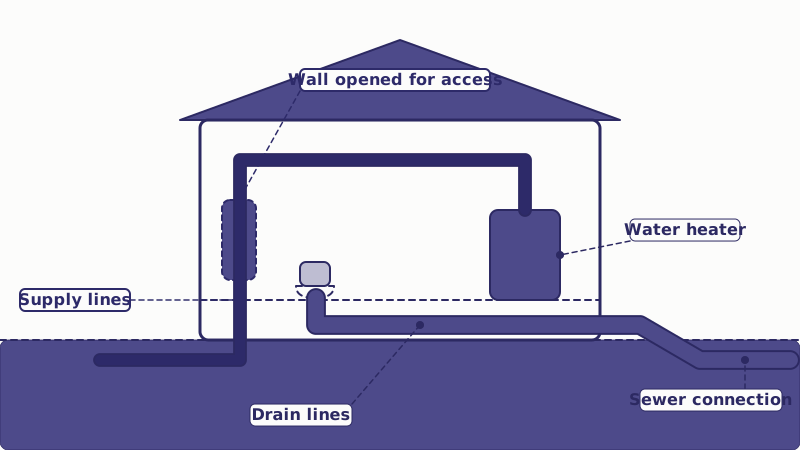
For an old house, most published guides put a whole-house supply repipe at roughly $4,000 to $15,000, with copper usually costing about double what PEX does. Drain replacement and wall repair come on top, and Los Angeles labor and permits push the figure toward the upper end. The sections below show what each part costs. You can also start from the plumber home page if you are still deciding what you need.
How much does it cost to replace the plumbing in an old house?
Expect roughly $4,000 to $10,000 for a 2,000 square foot house repiped in PEX, and roughly $8,000 to $18,000 in copper, based on published guides. Guides disagree widely, one putting PEX as low as $2,000 to $4,000, so treat every figure as a guide and rely on written quotes for your own house.
Labor is about 70 percent of the bill, according to the guides, which is why access matters more than pipe price. A single-story house with a crawlspace is the cheap case. A two-story stucco house with plumbing inside finished walls is the expensive one.
Here is the shape of a typical estimate for supply lines:
| Item | Typical range (guide) |
|---|---|
| PEX repipe, about 2,000 sq ft | $4,000 to $10,000 |
| Copper repipe, about 2,000 sq ft | $8,000 to $18,000 |
| Per square foot, PEX | about $2 to $6 |
| Per square foot, copper | about $4 to $14 |
| Wall and drywall repair afterward | $1,500 to $3,000 |
| Slab foundation surcharge | one guide adds around a third |
Per-square-foot figures swing because the guides count different things. Ask any plumber what the number includes before you compare.
What does "plumbing this old house" actually involve?
It means finding out what is in the walls before you plan anything. An old house can have several generations of pipe: original galvanized steel, copper added in the 1950s to 1980s, plastic patches, and cast iron or clay under the floor. The job is a survey first, then a scope, then a price.
Many Los Angeles homes built between the 1920s and 1950s have galvanized steel supply pipe. It rusts inward, so the opening narrows over time. That is why low pressure and brown water at the tap are common clues. Galvanized pipe replacement covers the signs in detail. Homes from the 1970s and 1980s may have polybutylene, a gray plastic pipe with a failure history, discussed under polybutylene pipe replacement.
A plumber will usually look at the water meter, the main shutoff valve, any visible pipe in the crawlspace or garage, the water heater connections, and a few fixtures. A camera inspection of the drain line is a separate paid step. See plumbing inspection cost for what that runs.
Do the drains need replacing too?
Not always, but check. Supply pipe and drain pipe fail differently. Drains in old homes are often cast iron or clay, and they can hold up for decades, but roots, cracks and scale cause slow drains and sewer smell. Replacement is priced per linear foot, and one published figure puts galvanized drain, waste and vent pipe replaced with copper at about $13 to $15 per linear foot.
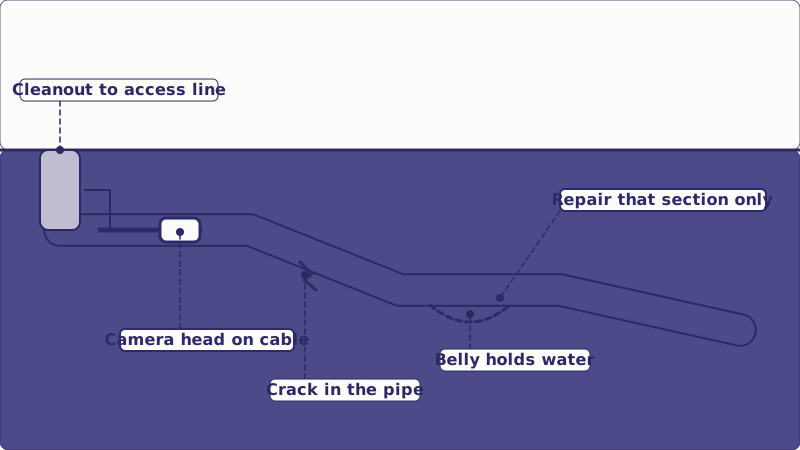
A camera run through the line shows the real condition. If the camera finds a belly or a crack, you can repair that section rather than the whole run. If you are redoing walls anyway, replacing the drain stack at the same time saves opening them twice.
Failure here is expensive. A cracked cast iron drain under a slab means breaking concrete. A plumber who explains what the camera showed, with pictures, is giving you what you need to decide.
What makes the price go up or down?
Access, material, house size and the condition of what is already there set the price. Anything that requires opening walls adds labor, and anything that lets the plumber run new lines through the attic or crawlspace without touching finished surfaces lowers it. Labor, not pipe, is the bulk of the bill.
- Number of bathrooms and fixtures. More fixtures means more branches and more valves.
- Stories. Two-story homes need more vertical runs.
- Foundation. On a slab, lines run overhead or through walls, or someone breaks concrete.
- Material. PEX is cheaper and faster than copper. Copper lasts a long time but costs more in material and labor. The comparison is in PEX versus copper.
- Hillside lots. Hauling materials up a steep driveway adds time.
- Pressure fixes. If street pressure runs high, a regulator may be part of the work. Learn more under water pressure regulators.
- Permit and inspection. Repiping needs a permit, which adds a fee and scheduling.
A partial repipe is an option. Replace the worst run, such as the line to the kitchen, and leave the rest. It costs less now, but you may pay mobilization a second time later. For the full-house route, see repipe house cost.
Do I need a permit to replace plumbing in a Los Angeles house?
Yes, a repipe needs a permit from the Los Angeles Department of Building and Safety, with inspections of the new work. The permit fee depends on how many fixtures are on the permit, and LADBS has an online fee estimator. Ask the plumber to include the permit in the written quote and say who pulls it.
The California Contractors State License Board says work that needs a permit must be done by a licensed contractor, whatever the job costs. For plumbing the classification is C-36. Check the license number on the CSLB website, and confirm it is active before any money changes hands.
California also limits the down payment on a home improvement contract to $1,000 or 10 percent of the contract price, whichever is less, and requires a written contract for jobs over $500 with a payment schedule that does not run ahead of the work. A repipe quote that demands a large deposit does not meet that rule.
Is it cheaper to repair than to replace?
Repair is cheaper this year. Replacement is cheaper over the life of the house if the pipe is failing. If you have had one leak, repair it. If you have had several pinholes in a few years, or low pressure and rust-colored water, you are paying for replacement in installments.
A rough test: ask the plumber to cut out a section and show you the inside of the pipe. Heavy scale, a nearly closed bore, or thin walls mean the rest is the same. A plumber who offers a single leak repair when the pipe is that bad is leaving you with the next failure.
Maintenance buys time. A working main shutoff valve, a pressure regulator set to a sensible level, and quick attention to drips all reduce failures in older pipe. They do not rescue a pipe that is rusted through. If the leak is already active, leaking water pipe repair explains the first steps.
What should the quote include?
A good quote names the pipe material, the scope by room, the permit, the wall repair, the water shutoff time, and the payment schedule. A single lump sum with no scope is not a quote. Ask for it on paper, and ask what happens if the walls reveal something unexpected.
Hard water matters for the choice of pipe in some areas. LADWP reports average hardness of about 8.6 grains per gallon in the San Fernando Valley and western Los Angeles, about 9.8 in Silver Lake, downtown and South Los Angeles, and about 16.3 in eastern Los Angeles and the Harbor area. Scale builds faster in the harder areas, so mention your neighborhood.
To get a written quote after a local plumber looks at your house, use our quote page. The steps are laid out on how a job runs.
Common questions
How long does it take to replace the plumbing in an old house?
A typical whole-house PEX repipe takes a few days, with water off for part of each day. Copper takes longer. Wall repair, painting and the permit inspection add time after the pipes are in. A plumber should give you a schedule that shows when the water will be off, since you will not have a working kitchen or bathroom during those hours.
What should I ask before I hire someone to replace old plumbing?
Ask for the CSLB license number and check it online. Ask which pipe material they propose and why, who pulls the permit, whether wall repair is included, and what the payment schedule is. Ask for the quote in writing. Also ask what happens if they find drain damage, and how an extra will be priced before it happens.
Does someone need to be at the property?
Someone needs to be there at the start, to show where the main shutoff valve is and approve what is being cut, and again for the inspection. During the work, plan for no water for stretches of the day. Many owners arrange access and stay elsewhere for the worst days. Move furniture and valuables away from walls that will be opened.
Can I do a repipe myself to save money?
In Los Angeles, a repipe needs a permit and inspection, and California licensing rules say permit work must be done by a licensed contractor. An owner can pull a permit for their own home in some cases, but it carries responsibility for the work. Small repairs like a faucet or fill valve are fine. Repiping a house is not a weekend job.
Is replacing old plumbing worth it before selling?
It depends on what the inspection finds. Buyers and their inspectors flag galvanized supply, polybutylene and active leaks, and some insurers ask about them. If pressure and flow are poor, the repipe often pays for itself in negotiation. If the pipes pass, spend the money elsewhere. Ask a plumber for a written condition report you can show buyers.