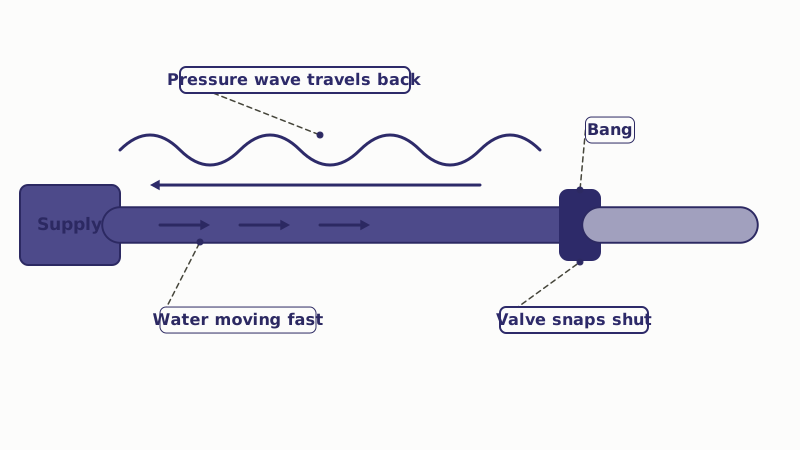
Water hammer is a pressure surge. When a faucet, valve or appliance shuts off quickly, moving water stops suddenly and the shock travels through the pipe, which you hear as a bang or a rattle. Often the cause is supply pressure above 80 psi, a waterlogged air chamber, or loose pipe. It is common in older homes and on hillsides. This guide explains how to tell which cause you have. The plumber home page lists the other plumbing jobs we arrange.
What is the banging sound when I turn off the water?
It is water hammer, also called hydraulic shock. Water moving through a pipe has momentum. When a valve slams shut, that momentum has nowhere to go, so it hits the closed valve and pressure spikes briefly. The pipe knocks against framing, and you hear a bang. Quick-closing valves in washing machines and dishwashers are the usual trigger.
Not every knock is water hammer. A ticking sound as hot pipes expand is thermal movement. A shudder or squeal while water runs is something else, often a worn washer or a partly closed valve. Water hammer happens at the moment flow stops. If your noise starts when the water stops, you are in the right place.
One bang is not an emergency. Repeated banging is. The spikes stress joints, fittings, hoses and the water heater, and a single failure can flood a wall. Treat it as a maintenance item you fix this month rather than a noise you live with.
Why do my pipes bang when the washing machine or dishwasher shuts off?
Those appliances use electric solenoid valves that close in a fraction of a second. That is the hardest stop in the house. The pressure spike is bigger when supply pressure is high, when the pipe run is long and straight, or when the air cushion that normally absorbs the shock is gone.
Many homes are built with air chambers: short capped vertical pipes behind fixtures that trap air to act as a cushion. Over the years the air dissolves and the chamber fills with water, so the cushion disappears. That is the most common reason an old house starts banging that never did before.
Other causes:
- High water pressure. Supply above 80 psi makes every spike worse.
- Failed pressure regulator. If one exists, a failing one lets full street pressure through.
- Loose pipe. Unstrapped pipe in a wall or crawlspace knocks against wood.
- Quick-closing fixtures. Single-handle faucets and toilets with fast fill valves close hard.
- Long runs. A far appliance at the end of a long pipe gets a bigger surge.
Is high water pressure behind the hammering in Los Angeles?
Often, yes. LADWP says pressure is set by ground elevation at each address, so hillside and valley-edge homes can see far higher pressure than flat neighborhoods. It says new residential plumbing in the City of Los Angeles needs a regulator when pressure can exceed 80 psi, and that older homes may have none.
That last point matters. A house built before that rule may have no pressure regulator at all, so the full street pressure reaches every valve. LADWP adds that regulators are installed and maintained by the property owner, usually above ground near where the pipe enters the house, and are normally set between 50 and 70 psi. LADWP will give you the maximum and minimum pressure for your address if you ask its water distribution section.
You can check your own pressure with a gauge that screws onto a hose bib. They cost little at a hardware store. Read it with every fixture off. Under about 60 psi, pressure is not your problem. Over 80 psi, a regulator is the fix, and it will cut the banging and extend the life of hoses and the water heater. A regulator that has failed can look identical to having none, so test it. See water pressure regulators for how they work and when they need replacing.
How do I stop water hammer in my house?
Start with the simplest fixes in this order. Recharge the air chambers, check the pressure, secure loose pipe, then add arrestors at the noisy appliance. Each step takes less effort than the next, and any one of them may solve it.
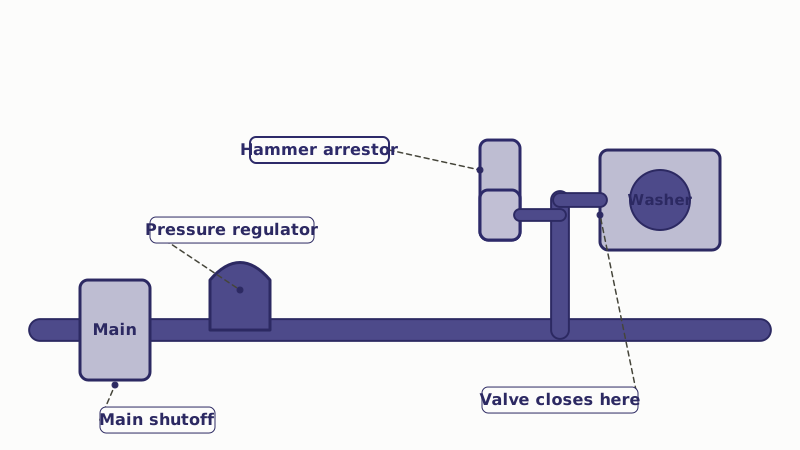
- Drain the system to recharge the air chambers. Turn off the water heater first (check its manual), then shut the main valve. Open the highest faucet in the house and the lowest, and let every line drain. Close the faucets, open the main slowly, and let air purge from each tap. The chambers refill with air, and you may get weeks or years of quiet.
- Test pressure. If the gauge reads over 80 psi, you need a regulator. This is a plumber job in the City of Los Angeles, and a thermal expansion tank may be needed with it.
- Secure the pipe. Where pipe is visible in a crawlspace, garage or basement, add padded straps. If the banging is inside a wall, a plumber can tell by sound where the loose section is.
- Add water hammer arrestors. An arrestor is a small sealed device that works like a shock absorber. Fit one close to the washing machine or dishwasher valve. Screw-on types go between the hose and the shutoff. Plumbing codes reference standards for them, so buy one that states compliance.
If draining and refilling works for a month and the noise comes back, the chambers are waterlogged again, and arrestors are the permanent fix.
How much does it cost to fix water hammer?
Costs run from nothing, for draining the lines yourself, to a few hundred dollars for a regulator or arrestors, and more if pipes behind walls need work. Published Los Angeles guides put plumber labor at about $100 to $200 an hour. A pressure regulator replacement is typically a bigger job than an arrestor.
A rough guide, with the caveat that real quotes depend on access:
| Fix | Typical cost (guide) |
|---|---|
| Drain and recharge air chambers | free if you do it yourself |
| Screw-on arrestor at a washer or dishwasher | modest parts cost, short visit |
| Replace or add a pressure regulator | a few hundred dollars up, more with an expansion tank |
| Re-strap pipe in an accessible crawlspace | one to two hours of labor |
| Fix pipe inside finished walls | quote after inspection |
For how plumbers charge, read how much a plumber costs per hour and plumber service call cost. A visit is often cheaper than the water damage from a failed fitting.
Can water hammer damage my pipes or water heater?
Yes, over time. Each spike strains soldered joints, compression fittings and washing machine hoses. In older galvanized or thin copper pipe it can be the push that opens a pinhole. It also pushes against the water heater, and a dripping relief valve is a clue that pressure is spiking or too high.
Signs the damage has started: a faucet that drips after you shut it, a washing machine hose bulging at the end, a toilet fill valve that fails often, or a stain appearing on a wall near a pipe. A burst fitting behind a wall means a flood, so if you see wet drywall, shut the main valve and call.
Replace the old rubber washer hoses with braided ones, and know where your main shutoff is. A valve that has not been turned in years can seize or fail when you need it. If yours does not close fully, replacing a shut-off valve explains what the job costs. If the heater is involved, see water heater expansion tank replacement.
When should I call a plumber for water hammer?
Call when draining the system does not help, when the gauge reads over 80 psi, when the banging comes from inside a wall, or when you see a leak, a bulging hose or a dripping relief valve. Regulators and anything involving a permit are plumber work.
Do not try to silence it by tightening everything or capping lines yourself. If you suspect a gas appliance is affected, do not touch gas piping. If you smell gas, leave the building, call SoCalGas at 1-800-427-2200 from outside, and call 911 if there is danger. Water and electricity do not mix, so keep wet hands off the panel.
A local plumber can read your pressure, find the loose pipe or empty chamber, and give a written price. To start, use our quote page, and see how a job runs for what happens next.
Common questions
How long does water hammer take to fix?
A drain-and-refill takes about an hour. Fitting a screw-on arrestor takes under an hour per appliance. Replacing a pressure regulator is usually a few hours with the water off. Chasing noise inside walls takes longer, because the plumber must find the loose section first. Ask for the water shutoff time up front so you can plan around it.
What should I ask before I hire someone to fix water hammer?
Ask them to measure static pressure before they quote and tell you the number. Ask whether a regulator and expansion tank are part of the fix, what the written price covers, and whether the visit fee counts toward the repair. Check their CSLB license number online, since regulator work can need a permit.
Does someone need to be at the property?
Someone should be home to let the plumber in, show the main shutoff, and approve any wall access. The water will be off for a while, so plan around that. You do not need to watch the whole visit, but be reachable by phone in case they find something that changes the price.
Is water hammer dangerous?
Usually it is a nuisance, but it can become a problem. Repeated pressure spikes weaken fittings and hoses, and a failure can flood a room. If the bang is loud, new, or comes with a leak, shut off the water at the main and have a plumber look at it soon.
Will a water hammer arrestor fix it permanently?
Often, if the arrestor is sized for the fixture and placed near the valve that causes the spike. It will not cure high supply pressure, though. If the gauge reads over 80 psi, fix that first, or you are quieting a symptom while the pipes and appliances take the stress.