In Los Angeles, most published price guides put a plumber's hourly rate at about $100 to $200, with a service call fee of roughly $75 to $250 on top, though a few report lower or higher figures. A fair rate is the one that comes with a written quote, a stated minimum, and a clear line between labor and parts. For a wider look at pricing, see the plumber home page.
How much should a plumber cost per hour?
Budget roughly $100 to $200 per hour for Los Angeles plumbing, going by published local guides, with a few putting the low end near $80 and the high end above $200. Rates run higher for emergencies, nights, weekends and specialty work such as gas lines. Treat the range as a guide, since every business sets its own.
The hourly number alone is not a good comparison. A plumber who charges $120 an hour and takes four hours costs more than one who charges $160 and takes two. What you want is the total for the job in writing. Many plumbers quote a flat price for common work, and bill hourly only when the cause is unknown.
Things that push the rate up: older homes where pipe is hard to reach, hillside driveways, work on a second floor, and jobs needing a permit. Things that bring it down: a clear scope, easy access, and bundling two small jobs in one visit.
What does the hourly rate include?
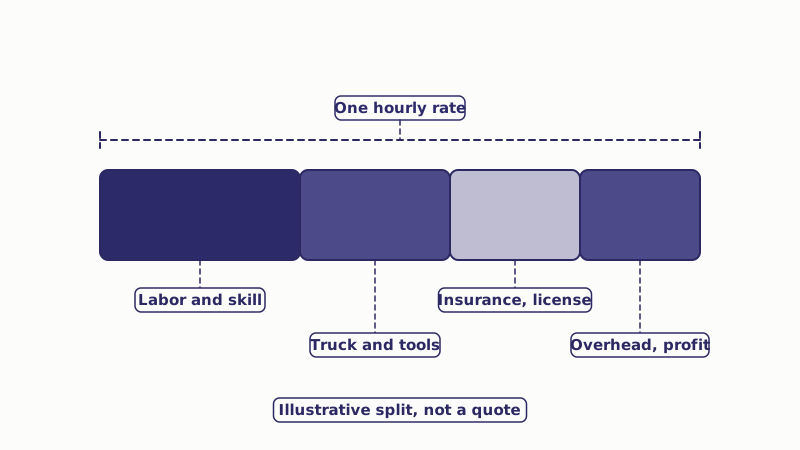
It usually covers the plumber's labor, tools, truck, insurance and overhead. It does not include parts, the permit, or the service call fee unless the quote says so. Ask what is included: whether travel time counts, whether there is a one-hour minimum, and whether the clock runs while they pick up parts.
Common billing styles:
- Pure hourly, billed in increments. Some bill in 15 or 30 minute blocks, others by the full hour.
- Minimum charge. Often one hour, even for a ten-minute fix.
- Flat rate. A fixed price per task, often set by a published price list. Good for known jobs, such as replacing a toilet fill valve.
- Time and materials. An hourly rate plus parts at a markup. Ask what the markup is on larger parts.
Labor is the largest piece of most plumbing bills. For a repipe, one set of guides puts labor at about 70 percent of the total.
What does a plumber's service call fee cost?
Published Los Angeles guides put service call fees at about $75 to $250, with some lower and a few much higher. The fee covers the trip and the first look. Some plumbers apply it to the repair if you go ahead and others keep it separate, so ask before anyone arrives.
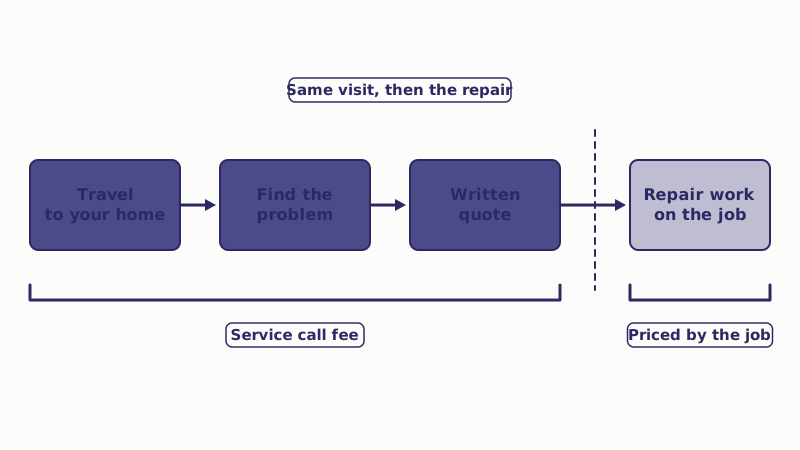
The full explanation is on plumber service call cost. The short version: get the fee and the credit policy on the phone, and treat a plumber who will not say as a warning sign.
How much do common plumbing jobs cost?
Any plumbing price list is only a guide, because the plumber sees the real job. These figures come from published guides, and Los Angeles prices usually sit toward the upper end of national ranges. Use them to spot a quote that is far off, not to predict your bill.
| Job | Typical range (guide) |
|---|---|
| Unclog a toilet | $100 to $300 |
| Faucet replacement | about $150 to $350 |
| Shower valve replacement in Los Angeles | about $170 to $625 |
| Burst pipe repair, plumbing only | roughly $500 to $4,000, plus water damage cleanup |
| Whole-house repipe, 2,000 sq ft, PEX | $4,000 to $10,000 |
| Whole-house repipe, 2,000 sq ft, copper | $8,000 to $18,000 |
For individual jobs, see unclogging a toilet, installing a faucet and repiping a house.
How much does a plumber charge to replace an outdoor spigot?
No published range for replacing a hose bib met our standard, so we will not make up a figure. The job is usually short and often priced as a flat rate or one hour, so expect it to land near the cost of a faucet replacement, about $150 to $350 in one guide. Ask for a flat price.
Cost goes up if the spigot is frozen to the pipe, if the shutoff for that line is missing, or if the pipe behind the wall is corroded and has to be cut back. In older Los Angeles houses, galvanized pipe at the spigot can snap when you try to unscrew it, which turns a small job into a bigger one. Putting in a new shutoff valve for the outside line costs a little more now and saves a flood later.
How much does a busted water pipe repair cost?
Guides put the plumbing portion of a burst pipe repair at roughly $500 to $4,000, with a simple accessible section at the low end and several failed sections at the high end. Water damage cleanup and drywall are separate and can exceed the pipe repair. Prices vary widely between sources.
If a pipe has burst, shut off the main valve first and open a faucet to relieve pressure, then call. Do not wait for the quote to stop the water. A plumber will find the break, cut out the damaged section and replace it, and may suggest a pressure check if the failure came from a spike. See burst water pipe and what causes pipes to burst for the steps. A repeated failure in old pipe can mean the run needs replacing, not another patch.
How much is plumbing per square foot?
Plumbing is not normally priced by floor area for repairs, but guides use it for repipes and new construction. Repiping runs about $2 to $14 per square foot depending on material and access. New-construction plumbing runs about $4 to $8 per square foot, with rough-in alone near $4.50.
For a 2,000 square foot new home with two or three bathrooms, one guide puts rough-in at $8,000 to $12,000 and rough-in plus fixtures at about $12,000 to $20,000. Another guide puts rough-in at $500 to $1,500 per fixture. These are planning numbers. A house with more bathrooms, a slab, or a long run to a detached unit costs more per square foot.
Rough-in is the pipe inside walls and under the floor before drywall, and fixtures are the sinks, toilets and tubs. If you are building or adding a bathroom, new construction plumbing explains the stages and the inspections. Ask whether the figure includes the permit and the water meter connection fees, which differ.
Does a free plumbing cost estimator work?
An online estimator gives a ballpark, not a price. It cannot see your access, your pipe material or what is behind the wall. Use one to check that a quote is in the right range, then get the real number from a plumber who has looked at the job.
The City publishes a plumbing permit fee estimator, which is reliable for the permit part of the cost because it counts fixtures. For the work itself, get a written quote that lists scope, parts, labor, permit and total. Free estimates are common for larger jobs, and some plumbers charge a fee for a visit that is credited if you go ahead.
How can I avoid overpaying a plumber?
Have the price written down ahead of any work, ask whether the service fee is credited, and compare scope rather than hourly rates. California requires a written contract for home improvement work over $500, with a payment schedule, and sets the down payment ceiling at 10 percent of the contract or $1,000, whichever is lower.
Other tactics: bundle small jobs into one visit, describe the problem precisely on the phone, and have the area cleared. Know where your main valve is, so the plumber does not bill time looking. Request a look at the failed part. If a quote includes a permit, ask who pulls it, because California licensing rules say permitted work needs a contractor with a California license.
A cheap rate with a long job, or a quote with no scope, is the usual way people overpay. For a written quote once the visit is done, use our quote page. See plumber cost for the broader picture.
Common questions
How long does a plumber visit take?
A simple repair such as a leaking faucet or a running toilet commonly runs one to two hours. Finding a hidden leak, replacing a water heater or repiping takes longer. Request a time estimate at booking, and ask whether the clock includes travel and parts runs. A short job can still carry a one-hour minimum.
What should I ask before I hire a plumber about cost?
Get the license number, the hourly rate, the minimum, the service call fee and any credit for it, and find out if the quote is hourly or a flat price. Ask what is excluded, such as the permit, wall repair or disposal. Make sure the final total is on paper before the job starts.
Does someone need to be at the property?
Yes, for the quote and sign-off. Someone should show the problem, the main valve and the work area, and confirm the price. For simple outdoor or crawlspace work you may only need to be reachable. Arranging access in advance, such as clearing under the sink, reduces billed time.
Is it cheaper to pay by the hour or a flat rate?
Flat rate protects you on known jobs, since a slow day costs the plumber, not you. Hourly is fairer when the cause is unknown, such as a hidden leak. Ask for a flat quote once the plumber has diagnosed the problem, and ask for a cap if they bill hourly.
Why do emergency plumbers charge more per hour?
Evening, weekend and holiday calls cost more to staff, and guides report emergency rates at 1.5 to 3 times standard, with after-hours hourly rates around $200 to $400. If the problem is contained, such as a dripping faucet, wait for business hours. If water is spreading, shut off the main first.