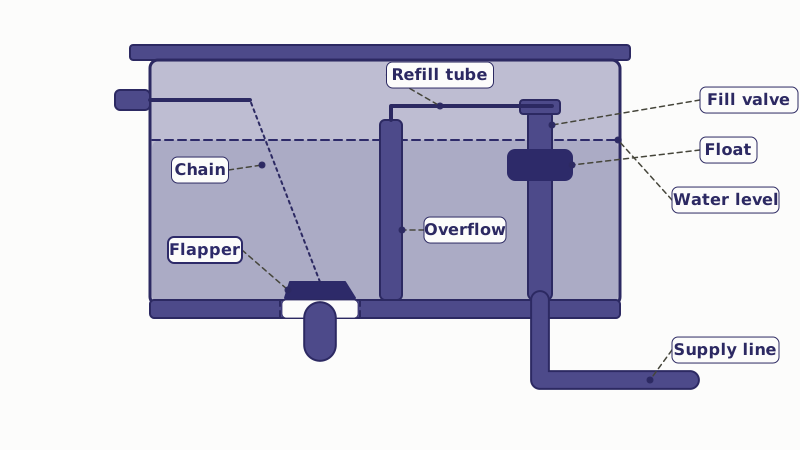
Your toilet keeps running because water is leaking out of the tank or the tank cannot tell when it is full. The cause shows up in the symptom. A hiss with no water movement points to the fill valve. A tank that refills every few minutes points to a leaking flapper. Water pouring down the overflow tube points to a level set too high. This page sorts the symptoms so you fix the right part, and the Toilets page lists the Toilet Repair Services we can arrange when the fix is not yours to make.
Why does my toilet keep running?
A toilet keeps running when the tank water drains into the bowl without a flush, or when the fill valve never shuts off. The flapper, the fill valve and the water level are behind nearly every case. Which one it is depends on whether the water level in the tank is dropping or sitting too high.
Lift the lid and look at the waterline before you touch anything. Then use this table.
| What you see or hear | Likely cause | First thing to try |
|---|---|---|
| Water touching the top of the overflow tube | Fill valve overfilling | Lower the float, or replace the valve |
| Tank level drops, then refills every few minutes | Leaking flapper or canister seal | Dye test, then replace the seal |
| Constant hiss, level looks normal | Fill valve worn or debris in it | Clean the valve, check the supply line |
| Handle stays down, water runs after a flush | Chain caught or handle stuck | Free the chain, check the handle arm |
| Faint trickle sound, nothing visibly wrong | Small flapper leak | Dye test in the tank |
What does it mean when the toilet runs every few minutes when nobody used it?
It means water is slipping past the flapper into the bowl, the tank level falls a little, and the fill valve opens to top it up. Replace the flapper or the canister seal and the cycle stops. If the flapper looks fine, the flush valve seat may be scaled or pitted.
This is the most common reason people write in about a toilet running when not in use. Because the leak is slow, the refill might happen every ten minutes or every hour, which is also why it is easy to ignore and easy to pay for. The EPA says a toilet leak can waste about 200 gallons a day at the high end, and that a worn flapper can quietly lose around 30 gallons a day.
Put a few drops of food coloring in the tank and leave it ten minutes. Color in the bowl confirms the leak. Flush afterward to keep the stain off the tank.
Why won't the toilet stop running after I flush?
The flapper is probably not dropping back onto the seat. Check the chain, which may be too short, tangled, or caught under the flapper, and check the handle arm for a bind. If the flapper is warped or the seat is rough, water keeps flowing even though the chain is fine.
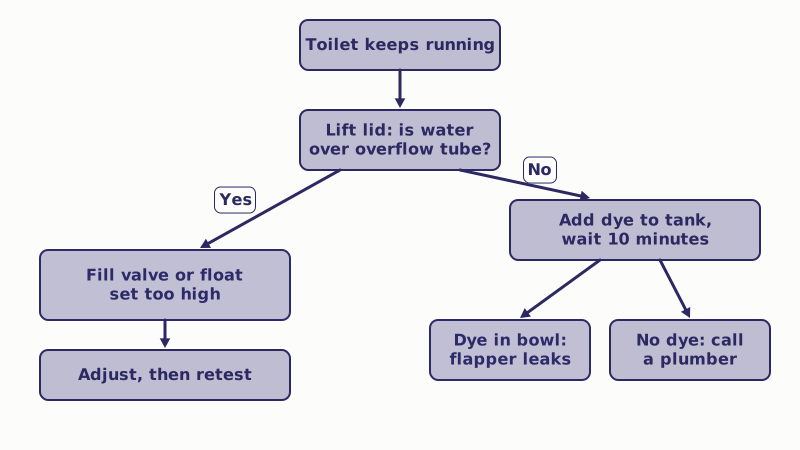
Wait a full minute after flushing and watch the flapper. It should settle flat within seconds. If it floats up or hangs open, the chain slack or a worn rubber edge is the reason. A few things to try, in order:
- Free any link of chain that is snagged on the lever or the flapper ears.
- Leave about a thumb's width of slack in the chain.
- Push the flapper down by hand. If the running stops, the flapper is not seating on its own.
- Replace the flapper if it is soft, sticky or curled. Our toilet flapper repair guide shows how.
When water runs after a flush and the tank also fills to the brim, the fill valve is not shutting off. That is a separate fault, covered below.
Why does the toilet sound like it is running or hissing?
A hiss usually comes from the fill valve, which is still letting water in because debris sits on its seat or its seal is worn. A trickle sound with no refill comes from a slow flapper leak. A gurgle with water spilling down the overflow tube means the level is too high.
Hissing that starts after a plumbing job nearby, or after the water was shut off and turned back on, often means debris moved into the valve. Shut the angle stop, remove the valve cap following the maker's instructions, flush the debris out with a short burst of water, and reassemble. Kohler's own guide says to clean debris from the seat and to replace the valve if its float sinks or the water climbs above the top of the canister.
Our toilet overflow tube repair page covers the case where the tube itself is cracked or the level cannot be controlled.
Why does a Glacier Bay dual flush toilet keep running?
Dual flush toilets use a push button or lever linked to a flush valve, and a running dual flush usually has a worn flush valve seal or a button that sticks halfway down. Dirt on the seal and a misadjusted fill valve are the other common causes. Check the manufacturer's manual for your model.
The two flush volumes mean there are two ways to hold the valve open, and a button that does not pop back up all the way can leave a gap. Press the button and release it, then watch whether it returns fully. If the button works, clean the seal with a soft cloth and test with dye. Parts differ between models, so use the model number printed inside the tank to buy a seal that fits. For the exact part on a Glacier Bay unit, the maker's parts list is the safest source.
Is a constantly running toilet an emergency?
A running toilet is not an emergency in itself, but it should not be left. A steady run can waste hundreds of gallons a day. Shut the angle stop behind the toilet to stop the water while you decide on the repair, and call a plumber at once if water is spilling onto the floor.
In Los Angeles, scale is one more reason a toilet starts running. LADWP calls water above 7 grains per gallon hard and reports 2022 averages of 8.6 grains in the Valley and West Los Angeles, 9.8 around Silver Lake, Downtown and South Los Angeles, and 16.3 in the east and the harbor area. Minerals build up on flapper seats and canister seals and stop them sealing. If you have lived with a toilet for a decade and it has started running, scale on the seat is worth a look before you replace anything.
If the leak is at the base of the toilet or at the tank bolts, that is a different problem from running. See our page on a plumber for a toilet leak.
When should you call a plumber for a toilet that keeps running?
Call a plumber when you have replaced the flapper and fill valve and it still runs, when the shut-off valve will not close or is leaking, or when the toilet is an older model whose parts you cannot match. A leak at the tank bolts or the tank-to-bowl gasket also needs the tank lifted off.
You do not have to work out the part yourself. We can arrange a local plumber to come to your home, check the whole toilet and give a written quote before any work starts. Tell us what you have already replaced on the quote page so the visit does not repeat it. If you want to try it first, our guide on how to repair a running toilet gives the step-by-step order. Come back to the home page for the rest of what we arrange across Los Angeles. You can thank the habit of a quick dye test for most of the savings.
Common questions
Why does my toilet bowl keep running?
Water in the bowl moving or refilling without a flush means the flapper or canister seal is letting tank water through. The bowl itself does not run. Replace the seal and clean its seat. If water in the bowl is dropping and rising, a partial clog or a hidden leak can also be involved, which a plumber can check.
Will a running toilet go away on its own?
No. The parts that fail do not heal, and scale or wear gets worse. A toilet that only runs now and then will usually run more often as the seal hardens. Fixing it early is cheaper than paying for the water, and a worn fill valve can eventually fail fully and overflow the tank.
Can I stop a running toilet by jiggling the handle?
Jiggling helps for a day or two if the chain is catching or the flapper is stuck, and it proves that the problem is mechanical. It is not a repair. If the toilet needs the handle jiggled every time, replace the flapper and fix the chain length so it stops needing attention.
How much water does a running toilet waste?
The EPA gives a range. A worn flapper can waste about 30 gallons a day. A toilet running constantly can waste around 200 gallons a day, and a fill valve stuck wide open can waste much more. The amount depends on how fast the leak is, so test with dye and fix it early.
Is it the fill valve or the flapper?
Look at the water level. If the water reaches the overflow tube, it is the fill valve or its float setting. If the level stays low but the toilet keeps topping off, the flapper is leaking. A dye test separates them, because color in the bowl means the flapper, and a clear bowl with a hiss means the fill valve.