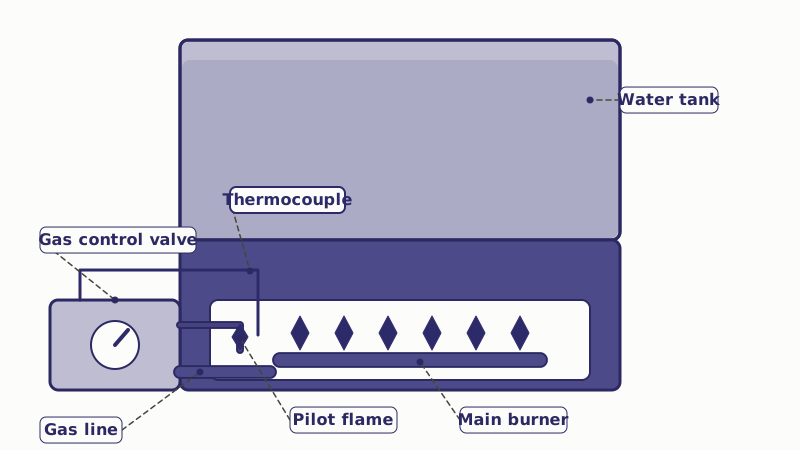
Relight the pilot only if you smell no gas at all. Turn the gas control to off, wait at least ten minutes, set it to pilot, hold it in and light the flame or press the igniter, then release slowly and turn it to on. If the flame dies again, the usual cause is a worn thermocouple, and that is a quick part swap for a plumber. If you smell gas at any point, leave and call SoCalGas. This page is part of our water heater coverage.
How do I safely relight a water heater pilot light?
First check for gas, since the manufacturer's rule is to stop if you smell it. Then turn the knob to off and wait at least 10 minutes so any gas clears. Set the knob to pilot and push it in, light the flame or press the igniter while holding the knob, and keep holding. Release slowly and set it to on.
Steps for a model with an electronic ignition button:
- Find the gas control valve near the bottom of the tank and read the label on it.
- Turn the knob to off and wait the full ten minutes.
- Set the knob to pilot and press it in about a quarter inch.
- Press the ignite button about once a second while holding the knob, for up to 90 seconds, until the pilot lights or the status light flashes.
- Release the knob slowly and confirm that the flame stays on.
- Turn the knob to on or to your temperature setting.
A manufacturer's guide says the status light should flash once a second. Older units with no button need a long lighter held at the pilot tube while you hold the knob in. Follow the label on your own heater, because the instructions differ by model. Never use anything but a proper lighter or match on a heater that has no electronic igniter, and keep your face back from the burner area.
Why does my water heater pilot light keep going out?
The most common reason is a thermocouple that has worn out or gone dirty, so it no longer senses the flame and tells the gas valve to shut. Other causes are a clogged pilot orifice, drafts, a blocked vent, low gas pressure, or a failing gas control. A pilot that dies the moment you let go of the knob points at the thermocouple.
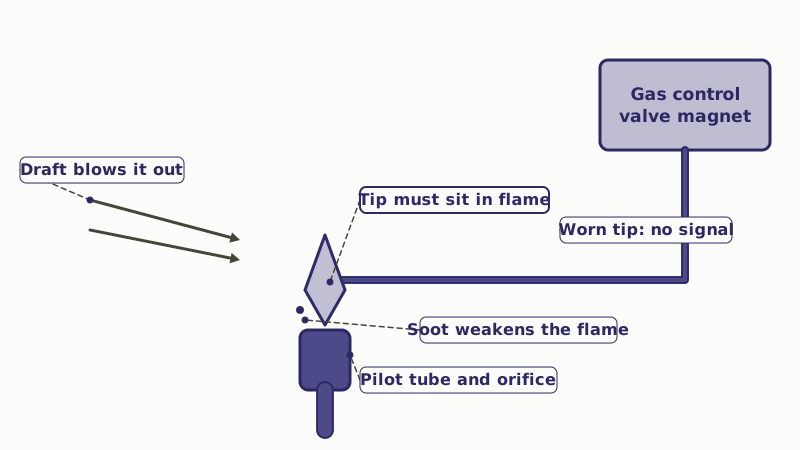
Hold the knob in for the full time. If you release it too early, the thermocouple has not heated enough and the flame drops out, which looks like a fault but is a technique problem. If it still fails after a full hold, the part is the likely culprit. Our page on thermocouple water heater replacement covers that part in detail, including the price.
A pilot that goes out only on windy days or when a bathroom fan runs can mean a draft or a venting issue. That should not be left, since a gas heater that backdrafts can release combustion gases into the room. Call a plumber the same day for that sign.
Why is the pilot light on but there is no hot water?
When the pilot is lit and the water is cold, the pilot is not the problem. The main burner is failing to fire, the thermostat is set too low, the gas control valve has failed, or the burner is clogged. Another possibility is that gas pressure is low, or the tank is full of sediment and the water reads cooler than it should.
Quick checks you can do safely:
- Turn the temperature dial up a notch. A dial set to vacation or low can leave the burner idle.
- Look through the viewing window, if there is one. A main burner with a yellow or lazy flame needs a plumber.
- Check whether hot water is available at every tap, because a mixing valve or a cold-side crossover can imitate a dead heater.
If the pilot is on and the main burner never lights, the gas control valve or thermostat is the likely fault, and a plumber needs to test it. Our full guide on repairing a gas water heater walks through the burner, vent and control checks. For no hot water in the whole house, see why you have no hot water.
How much does pilot light repair cost?
Small repairs such as a thermocouple or thermostat typically run about $100 to $350 with labor, based on national figures from HomeGuide, and the part itself is often $10 to $30. A heater that needs a new gas control valve costs more, and I did not find a published price I would rely on.
The call itself is often the cost driver. A relight that works costs little, while a repeat failure means diagnosis. If the heater is old and the repair keeps recurring, compare with replacement. See water heater replacement cost for guide prices on new units, which could be a better use of money.
If the water heater is the only gas appliance acting up, the thermocouple is the first suspect. If the stove or furnace also misbehaves, the problem may be with gas supply, which belongs to SoCalGas or a gas line plumber.
When should I call a plumber for a pilot light problem?
Call a plumber if the pilot will not stay lit after two careful tries, if you smell gas at any time, if you see soot or scorch marks, if the status light does not respond, or if you do not feel confident relighting it. California law requires a contractor license for gas work, so anything beyond a relight should go to a professional.
For gas smell: leave first, then call SoCalGas at 1-800-427-2200 from outside, and 911 if there is danger. SoCalGas says not to use switches, flames or devices that could spark. If your heater is down and you need hot water today, read about emergency water heater repair.
Send us a quote request with the brand, the age of the heater and what the pilot does. A local plumber visits and gives you a written price. You can also return to our home page to see the rest of the services.
Common questions
How long does a pilot light repair take?
A relight takes a few minutes. Replacing a thermocouple usually takes under an hour for a plumber with the part on the truck. Cleaning the pilot assembly or replacing a control valve takes longer, and a second visit may be needed if a part must be ordered. The plumber can give a better estimate after testing.
What should I ask before I hire someone for pilot light repair?
Ask if the visit includes testing the thermocouple, the burner and the flue, and whether the quote covers the part. Ask whether they check for gas leaks after the work. Ask what they recommend if the heater is old. Get the price in writing before they start the repair.
Is it dangerous if my pilot light goes out?
An out pilot is usually safe, because the gas control shuts off gas when the flame is gone. The risk comes from relighting without waiting for gas to clear, or from a heater that backdrafts. If you smell gas, leave and call SoCalGas. If not, wait ten minutes and relight following the label.
Does someone need to be at the property?
Yes, someone should be home to let the plumber in and to test the heater with them. The gas to the heater is turned off for a time, and you may be asked to approve a change to the quote. Renters should tell the landlord first, since the heater normally belongs to the building.