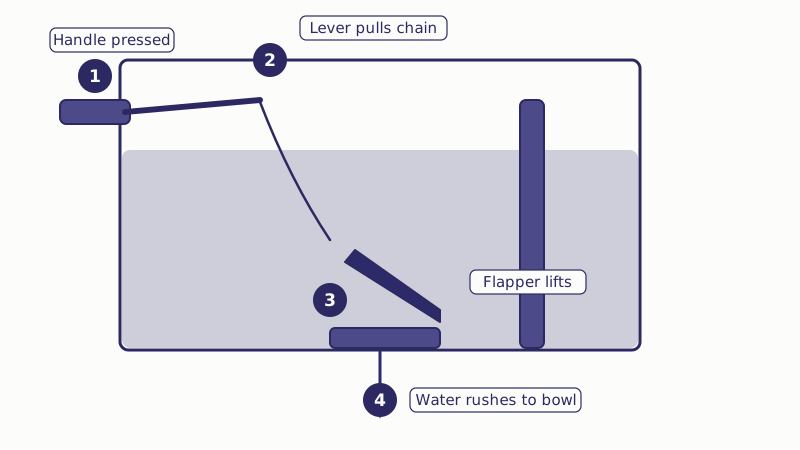
A toilet that flushes weakly, flushes only halfway or will not flush at all has a problem in the mechanism that lifts the flapper or the canister and lets the tank water drop into the bowl. A loose handle, a stretched or disconnected chain and a worn flush valve account for almost every case. Each one is repairable, and most take under an hour. The wider list of repairs sits on our Toilets page, which also covers the Toilet Repair Services we can arrange when the fix is beyond a handle or a chain.
How do you repair a toilet that will not flush properly?
Check the handle first, then the chain, then the tank water level. A handle that moves with no resistance usually means a loose nut or a chain that came off the lever arm. A weak flush often means the water level is too low or the flapper closes too early. Fix those before you replace anything.
Take the tank lid off and press the handle slowly. You should see the lever arm lift the chain, which lifts the flapper. Whichever link of that mechanism fails to move is your repair. Also compare the waterline to the mark inside the tank. If the water sits well below it, the flush has less water behind it and comes out weak, which is a float or fill valve adjustment, not a flush valve fault.
How do you fix a loose toilet handle that will not flush?
Take off the tank lid and look at the back of the handle. Tighten the mounting nut, which is reverse-threaded on many toilets, so turn it the way that feels opposite. Reconnect the chain to the lever arm if it has slipped, leaving a little slack. If the handle is cracked or the arm is bent, replace the handle assembly.
The handle mounting nut is often left-hand threaded, which is why people tighten it the wrong way and loosen it further. Turn it counterclockwise to tighten. Do not overtighten it, because the tank is porcelain and cracks easily.
A handle that is tight but does not lift the flapper usually has a chain that is too long. Shorten it by moving the clip to a different link. Leave about a thumb's width of slack, so the flapper can still close fully when the handle is released. A chain that is too short holds the flapper slightly open and the toilet runs, which is a different repair covered on our running toilet page.
How do you repair a toilet flush valve?
A flush valve repair means replacing the flapper or canister seal and cleaning the seat it closes on, which is the drain opening at the bottom of the tank. If the seat is cracked or heavily pitted, or the overflow tube is leaking where it meets the tank, replace the whole flush valve.
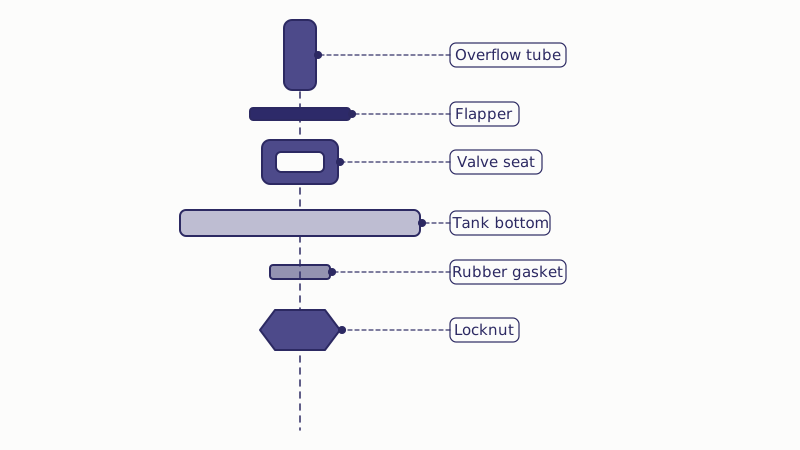
The flush valve is the large drain assembly in the middle of the tank. Water leaves through it every time you flush, and it has to close tightly afterward. Wear shows as water sneaking into the bowl, which then triggers the fill valve again, and the toilet starts running after the flush. A dye test finds it. Put food coloring in the tank and wait ten minutes without flushing. The EPA's WaterSense program recommends this test, and color in the bowl means the flush valve seal is leaking.
Los Angeles water is hard, and LADWP classifies water above 7 grains per gallon as hard. Scale on the seat can stop a new flapper sealing, so wipe the seat before you fit the new part. Kohler's guide also suggests cleaning mineral deposits from a canister with vinegar and water.
Can you replace a toilet flush valve without removing the tank?
For some toilets, yes, but only with a repair kit designed to seal over the old seat, and only when the valve itself is sound. If the flush valve is cracked, or its gasket leaks at the tank bottom, the tank must come off the bowl to replace the valve properly.
Flush valve repair kits exist that fit onto the existing overflow tube and give a fresh sealing surface, which saves removing the tank. They suit a worn or scaled seat, and the maker's instructions say which toilets they fit. Treat that as a short-term fix on an old toilet.
A complete replacement means shutting off the water, draining the tank, undoing the supply line and the tank bolts, lifting the tank off, swapping the valve and its gasket, and refitting with new bolts and washers. A tank is heavy and fragile, so many people choose to have a plumber do this. We can arrange a local plumber and give you a written quote first.
How do you repair a toilet float or fill valve?
If the toilet fills slowly, overfills or hisses after a flush, adjust the float so the water stops about an inch below the top of the overflow tube. If adjustment does not hold, replace the fill valve, which is a standard part and does not need the tank to come off.
The float is the cup or arm that tells the fill valve when to stop. On a cup-style valve, turn the adjustment screw or slide the cup along the rod to change the level. On an older ball-and-arm ballcock, bend the arm gently. Our toilet fill valve repair guide takes you through replacing one. If water reaches the overflow tube and runs down it, your toilet will run until the level is lowered.
Why does a toilet keep running after a flush?
A toilet runs after a flush when the flapper or canister seal does not close again, or the fill valve does not shut off. Check that the chain is free, the flapper seats flat, and the water level is below the overflow tube. A seal that has hardened or scaled will leak even with the chain correct.
After the flush the flapper should drop within a few seconds and the tank should refill and go quiet. If it keeps running, one of those three parts is failing. Replace the cheapest part that matches the symptom first, which is the flapper in most cases, then test again.
How old is too old to repair a toilet in Los Angeles?
If your toilet uses more than 1.6 gallons per flush, parts are harder to find and repair may not be worth it. California's water-conserving fixture law set 1.6 gallons per flush as the limit for toilets and required older single-family homes to replace non-compliant fixtures by January 1, 2017.
Toilets made before the 1990s generally used more water per flush than today's, and many Los Angeles homes still have one. If yours is an older model with a cracked tank, a rusted flush valve nut or a porcelain finish that is crazed, the cost of a new toilet and its installation may be the better spend than another repair. A plumber can tell you which it is when they see it.
When should you call a plumber for toilet flush problems?
Call a plumber if the tank is leaking at the bolts or the flush valve gasket, the tank is cracked, the shut-off valve will not close, or parts for an older toilet no longer match anything you can buy. Anything that needs the tank lifted off the bowl is easier with a second person and the right tools.
If you would rather not do it, we can arrange a local plumber to come to your home, look at the whole flush system and give you a written quote before any work starts. Use our quote page and describe the symptom so the visit starts in the right place. If the water leak is the main trouble, see plumber for toilet leak as well. Your wallet will thank you for fixing it early. Everything else we arrange across the city is on the home page.
Common questions
How much does a toilet flush repair cost?
Parts such as a flapper, chain, fill valve or handle are low-cost hardware store items, and many people fit them in under an hour. A plumber's visit adds labor and a call-out charge, so the total depends on the job. We can arrange a local plumber who gives a written quote before work starts, so you see the number first.
Why is my toilet flush weak?
A weak flush usually comes from low water in the tank, a flapper that closes too early, or partial blockage of the rim holes or the siphon jet under the rim. Raise the fill level to the mark inside the tank and check the chain slack. Mineral scale around the rim holes is common with hard water and can be cleared with vinegar.
How do I know if the toilet flush valve is bad?
Water leaking into the bowl, color in the bowl after a dye test, a running toilet that returns after you replace the flapper, or visible cracking or pitting on the seat all point to the flush valve. If the overflow tube is loose or wet at its base, the valve has failed and needs replacing.
Can I flush with a bucket when the handle is broken?
Yes. Pour about a gallon of water quickly into the bowl and it will flush the same way. That is a stopgap only. A broken handle usually means a broken chain or lever, which costs little to fix, so repair it in the same day rather than living with a bucket.
Is toilet flush repair something I can do myself?
Replacing a handle, chain, flapper or fill valve is within reach of most people with basic tools. Replacing the whole flush valve means lifting the tank, which carries a risk of cracking the porcelain. Anything involving the shut-off valve or supply line that leaks, or any toilet that is loose on its base, is better left to a plumber.