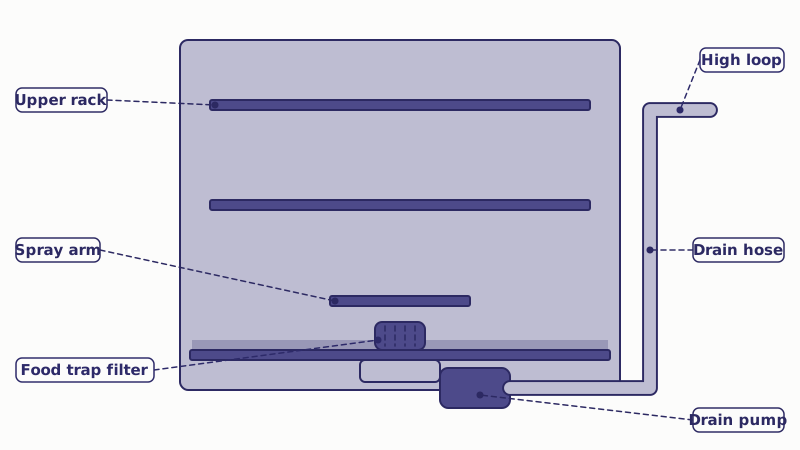
To unclog a dishwasher drain, turn off the power, scoop out the standing water, pull the filter and rinse it, then check the drain hose and where it joins the garbage disposal or sink drain. Most dishwashers that will not empty are blocked by food debris in the filter or by a clog in the sink side of the connection, not by a failed machine. The steps below go from easiest to hardest. If your kitchen sink is also slow, read our guide to drain cleaning and clogs first, because the cause is shared.
Why is my dishwasher not draining?
A dishwasher stops draining when something blocks the path from the tub to the sink drain: a clogged filter, a kinked or packed drain hose, a garbage disposal that is full, an air gap packed with grease, or a clog in the sink drain line itself. A failed pump is possible but far less common.
Start with the simplest check. Run the garbage disposal with cold water for 15 to 20 seconds, then run a short drain cycle on the dishwasher. If the water goes, the disposal was holding food waste that blocked the outlet. If the kitchen sink holds water when you run the dishwasher, or the sink drains slowly on its own, the problem is the shared line. In that case the dishwasher is a symptom, and you should fix the slow kitchen sink first.
Look for the obvious. A bent hose behind the machine, a cracked hose, or a new disposal installed without opening a plastic plug inside the dishwasher inlet will all stop the machine emptying.
How do I clear the filter and the bottom of the dishwasher?
Turn off the breaker for the dishwasher, take out the bottom rack, and lift out the cylindrical filter and the flat cover at the base of the tub. Rinse them under warm water with a soft brush. Scoop the water out with a cup and a towel, wipe the sump, then press the filter back in until it locks.
The filter is where most of the debris ends up: rice, seeds, eggshell, glass fragments, label paper and a gray paste of grease and soap. Wear gloves, because broken glass is common. Look in the sump below the filter for a bone, a toothpick or a bottle cap that could jam the pump. Check your owner's manual for the exact filter design, because makers differ. If you do not have the manual, search the model number printed inside the door frame.
Rinsing dishes lightly and scraping plates into the trash, not the drain, keeps this part clean. Dishwasher cleaning tablets or a hot cycle with a cup of white vinegar in the bottom of an empty machine handle the film on the walls, but they cannot clear a blocked pump or hose.
How do I unclog a dishwasher drain hose?
Pull the dishwasher forward after turning off the power and water supply. Find the drain hose, which runs from the machine to the disposal or sink drain, and disconnect it at the lower end over a bucket. Run water through it or push a flexible brush through to clear it. Check for kinks, then reconnect and tighten the clamp.
Keep towels under the machine, because the hose still holds water. If the hose is stiff, cracked or collapsed, replace it with the same diameter and length. A hose that is cleared but still sags can trap water, so check how it is routed. Many homes use a high loop, where the hose rises to the underside of the countertop and is clipped there before it drops to the drain. It keeps dirty sink water from running back into the dishwasher. Make sure the loop is up and not hanging down.
Some kitchens use an air gap instead, a small chrome or plastic cap beside the faucet. A short hose connects it to the disposal or drain. Grease and food can pack that hose. Lift the cap, clean it with a bottle brush and flush it. If water spits from the air gap during a cycle, a clog downstream is the usual cause.
Can the garbage disposal or kitchen sink cause my dishwasher drain to clog?
Yes. Most dishwashers drain through the garbage disposal or the sink's drain line, so a full disposal or a grease-lined sink pipe blocks the dishwasher too. A new disposal may also still have an unremoved plastic knockout plug in its dishwasher inlet, which blocks drainage completely.
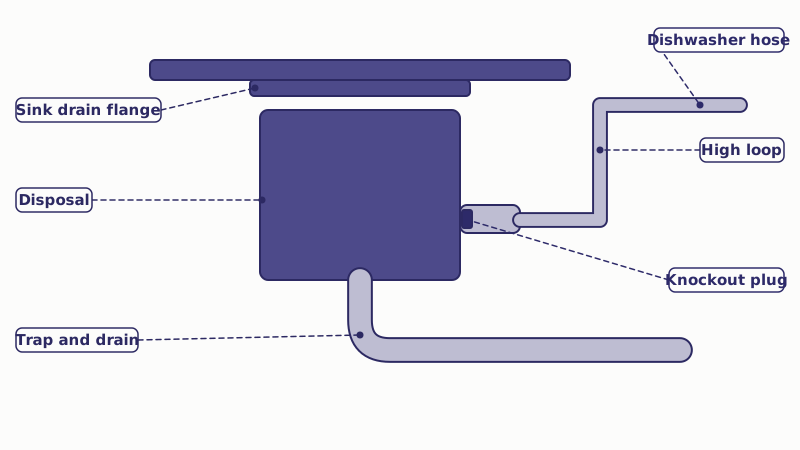
If the disposal was installed recently and the dishwasher has never drained properly, ask the installer whether the plug was knocked out. To check it, switch off the power at the breaker, then look into the disposal inlet. Pushing the plug out is a job for a screwdriver and a firm tap, and the loose plug must be retrieved from inside the grinding chamber before you restore power. A plug left in is a common reason a new dishwasher never drains.
Disposals do not grind everything. Cooking grease cools into a solid layer in the pipe. LA Sanitation says to keep grease out of sinks and disposals and to put cooled fat into a sealed container in the trash. If you are dealing with a jammed or full disposal, see our guide on how to unclog a garbage disposal drain.
Is it safe to use baking soda, vinegar or drain cleaner in a dishwasher drain?
Baking soda and vinegar are safe in a dishwasher's drain path but only loosen light film. Chemical drain cleaners are not: they can damage the hose and rubber seals, they can splash back on you, and they must never go in an air gap. Use a brush, a snake and hot tap water instead.
If you used a store-bought cleaner earlier and it did not work, do not mix it with vinegar, baking soda or bleach, and do not use a plunger on top of it. Mixed cleaners can throw hot liquid or release toxic fumes. Open a window and call a plumber. For skin or eye contact, or fumes you have breathed, rinse and call Poison Control on 1-800-222-1222.
A gentler routine works better over time. Once a month, run the disposal with cold water, pour a kettle of hot tap water down the sink, and run a hot dishwasher cycle empty. That keeps film from building and clearing it is easier before it hardens.
When should I call a plumber for a dishwasher drain?
Call a plumber if the kitchen sink also drains slowly, if water backs up from the dishwasher into the sink, if the clog returns within days, or if the drain line runs inside a wall or cabinet you cannot open. The cause then sits in the sink drain or the main kitchen line, not in the machine.
Los Angeles homes built in the 1920s through the 1950s often still have steel or cast iron kitchen drain lines, which narrow with rust and grease over decades. A line like that gives out the same way again and again. We will arrange a local plumber to come to you, with a written quote before any work starts. Ask for one on the quotes page, or read how a job runs.
Published Los Angeles prices put clearing a single kitchen drain at roughly $110 to $350. Our cost to unclog a sink page has the breakdown. If the dishwasher itself has a failed pump or a bad drain valve, an appliance repair specialist is the right call, not a plumber. For general plumbing needs across the city, start at the home page.
Common questions
How long does it take to unclog a dishwasher drain?
Cleaning the filter and running the disposal takes about 15 minutes. Pulling the machine out to clear the drain hose usually takes 30 to 60 minutes with the clean-up. A plumber clearing the sink drain line behind it often finishes within an hour, longer if a camera or a second access point is needed.
What should I ask before hiring someone for a dishwasher drain clog?
Ask whether they will clear only the dishwasher connection or the whole kitchen drain line, what the call-out fee covers, whether a camera inspection costs extra, and what happens if the clog is deeper than expected. Get the answers in the written quote before they start, not after.
Does someone need to be at the property?
Yes, or an adult you trust, because the plumber needs to reach the cabinet under the sink and sometimes pull out the dishwasher. Clear the space first and empty the cabinet. Tell the plumber about any disposal installation work or earlier clog treatments you used, since chemicals change how they approach the job.
Why does my dishwasher drain into the sink?
If the hose connects to the disposal or an air gap, the sink and dishwasher share one drain, so a clog there shows up in both places. Dirty water appearing in the sink during a cycle means the line past the connection is partly blocked. Clear the sink drain and check the high loop or the air gap.
Can I put a plunger on a dishwasher drain?
Not on the dishwasher itself. Do not plunge through the machine. If both sink bowls are blocked, a plunger on the sink drain with the other side plugged can help. Never use a plunger after chemical drain cleaner, and never force water back toward the dishwasher inlet, which can damage seals.